
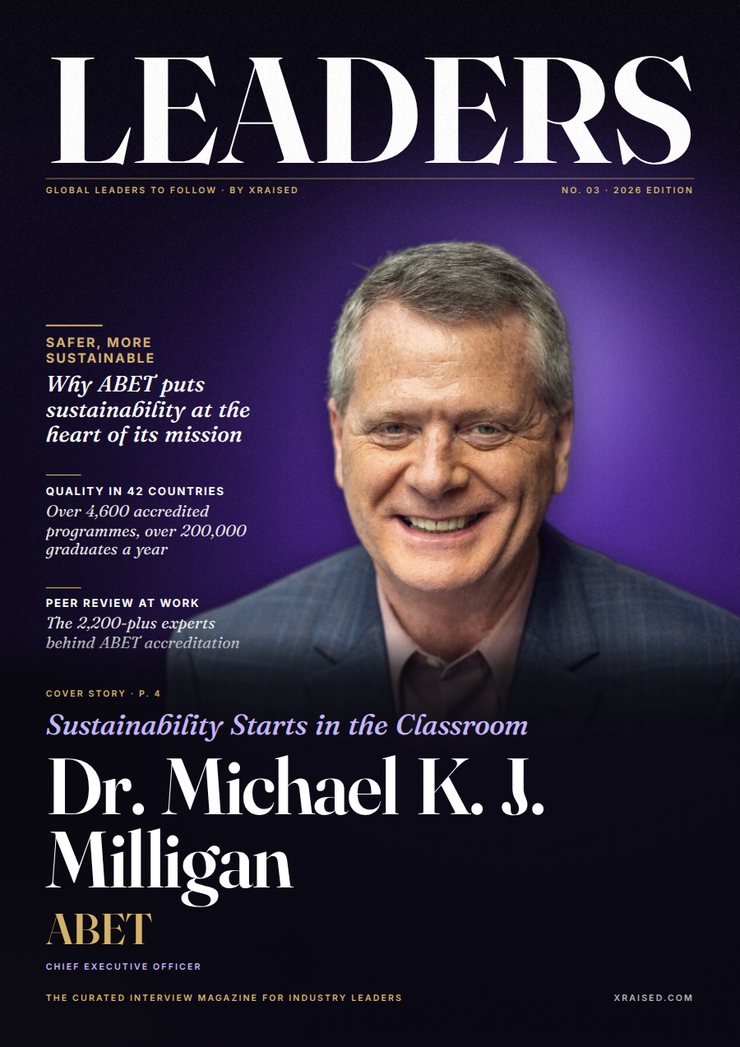
Dr. Michael K. J. Milligan
ABET Chief Executive OfficerSustainability Starts in the Classroom
Dr. Michael K. J. Milligan has led ABET since 2009. He sees sustainability not as an add-on to quality education, but as part of what accredited STEM programmes must prepare graduates for.
Dr. Michael K. J. Milligan can sum up the purpose of the organisation he leads in a single sentence: “Together, we ensure that the leaders of tomorrow are building a world that is safer, more efficient and more sustainable.” It is the last of those words that brought him to Xraised. As Chief Executive Officer of ABET, Milligan wanted to talk about how sustainability fits into the organisation’s mission and strategic goals, and why it sits naturally alongside quality education.
His own tenure is a long one. “I’ve been the CEO of ABET since 2009 and have thoroughly enjoyed my journey leading this unique organization,” he says. From ABET’s headquarters in Baltimore, Maryland, he is responsible for all aspects of its global operations and reports directly to the ABET Board of Directors. Since he joined, the organisation has diversified its technical and geographical impact. It now represents 34 technical and professional societies and more than 4,600 accredited academic programmes in 42 countries, which together graduate over 200,000 students each year.
ABET describes itself as a nonprofit, ISO 9001 certified quality assurance organisation. Founded in 1932 as the Engineers’ Council for Professional Development, it supports excellence in education through the accreditation of academic programmes, the recognition of credentials and the assessment of student learning. Its accreditation looks at the programme rather than the institution as a whole, so that the specific course of study a student follows in applied and natural science, computing, engineering or engineering technology meets peer-reviewed standards.
Those standards are set by people from the professions themselves. ABET’s member societies develop the criteria, and more than 2,200 ABET Experts from industry, academia and government volunteer as programme evaluators, commissioners, board members and advisors. Milligan puts their role at the heart of the organisation’s reach: “Together with more than 2,200 ABET Experts, we help shape the educational experience for thousands of STEM college students and working professionals around the world.”
Seen in that light, sustainability is not a departure from ABET’s work but an extension of it. The organisation’s overarching aim is to help equip the professionals of tomorrow to build a safer, more efficient and more sustainable world, and that places sustainability alongside its quality assurance work rather than apart from it. If accredited programmes exist to prepare graduates for the workplace, and that workplace increasingly expects sustainability fluency, then the programmes have to reflect it.
Milligan describes a shift that is now visible across STEM higher education. Employers increasingly want graduates who can apply strong technical skills with an awareness of environmental responsibility, ethical considerations and long-term impact on society. Accreditation bodies are well placed to respond, because their criteria shape what programmes teach and how student outcomes are measured. ABET has also begun applying its quality assurance standards to microcredentials and certificate programmes that build sustainability into professional development.
Milligan is clear that ABET’s sustainability efforts are broader than any single initiative, though two examples show the thinking in practice. The ABET Sustainability Microcredential, developed with Online Education Services, is a self-paced online programme exploring how applied science, technology, engineering and mathematics intersect with the United Nations Sustainable Development Goals. And for the ABET Symposium and other events, a partnership with Evertreen plants a tree for every attendee who registers, with the results visible in an ABET Forest on the Evertreen platform.
Looking ahead, the goal is integration: sustainability embedded across accredited STEM education as a whole, rather than confined to particular programmes or elective courses. The measure of success is a practical one. Do the graduates of ABET-accredited programmes leave with the knowledge, skills and values to contribute to a more sustainable world? That question will keep shaping ABET’s direction, through its accreditation criteria, its recognition of credentials and the partnerships it chooses. In Milligan’s words, “Our services and global partnerships help equip professionals to confidently face the future.”