
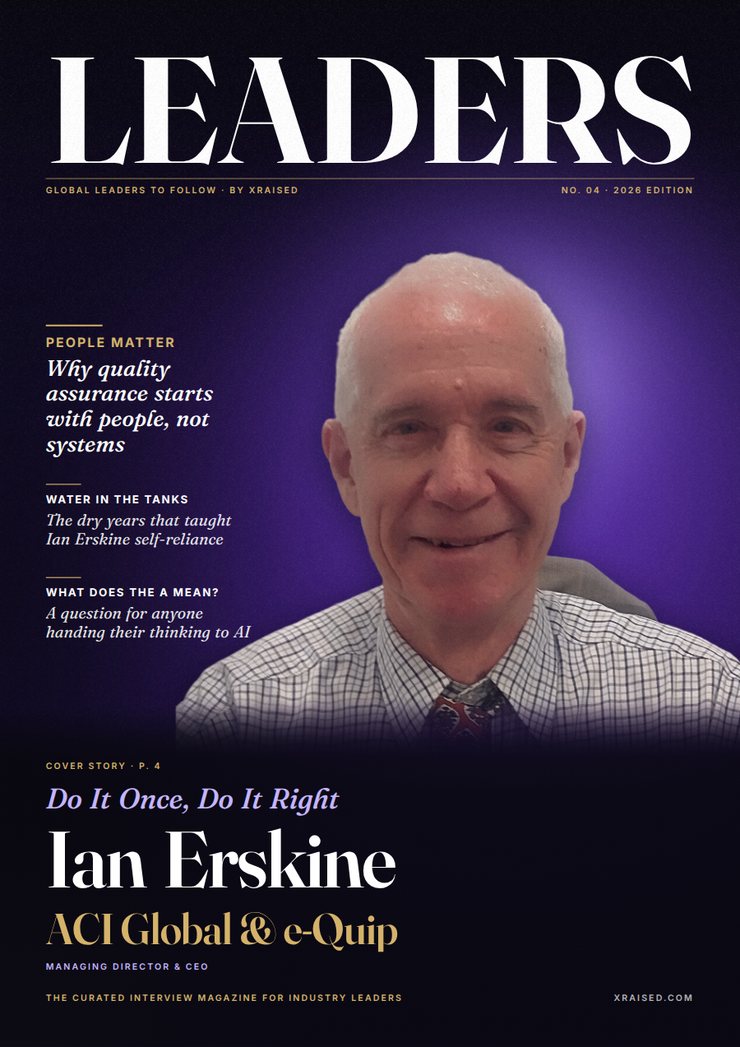
Ian Erskine
ACI Global & e-Quip Managing Director & CEODo It Once, Do It Right
Ian Erskine has drought-proofed a farm, run a depot as if it were his own and made 105 appearances on Xraised. His conclusion never changes: quality is not made by systems. It is made by people.
Early one morning, not long after a very dry spell, Ian Erskine rode his bike over the hill to one of the stock troughs on the family farm. The sheep were coming down for water. He got off the bike, saw how happy they were, and did a little dance around it. Anyone watching from afar would have seen a man dancing among his sheep; “what a strange sight that would be,” he concedes. But it was the morning a hard-won goal paid off.
The property was large and dry, with 12 inches of average rainfall and, in some years, virtually nothing. Crops could not always be planted and water had to be carted to the stock. When Erskine’s second son, Brian, was born and Loretta brought him home, there was almost no water in the tanks. The answer was large storage on the machinery sheds and a piping system to carry water across the properties. “We literally drought proofed our farms,” he says, and they never ran out of water again. Self-reliance, in his telling, starts there: set the goal, solve the problem yourself, and let the happiness of achieving it carry you on.
Today Erskine is Managing Director and CEO of ACI Global and e-Quip, a third-party auditor and trainer with more than four decades in organisational quality, people development and performance improvement. He is also among the most familiar voices on Xraised, with 105 appearances to date. Whatever the subject, he returns to the same convictions. People matter. Do it once, do it right. And Total Quality Management’s Plan, Do, Check, Act, which, as he puts it, “applies to everything we do.”
Farming was always in his blood. Leadership, he insists, is something you learn, and he learned much of his in senior roles with Elgas and AGL. Of the AGL depot he ran in Western New South Wales, he says: “I ran that business as if it was my own.” He would invite employees into his office to tell him what he, as a manager, could be doing better. Sometimes they took him to task. “And more often than not, yes, I was being a goose.” He urged his team to strive to do better than him, or to run their own business one day; one, in Dubbo, bought a Barbecues Galore franchise and still runs it. A senior manager from those years gave him advice he still follows: aim to experience something new every day.
That instinct for drawing people in shapes ACI Global’s work. Its tools begin with the individual: Hogan personality profiles, and a 360-degree review in which managers, colleagues and outside stakeholders rate a person’s performance. The e-Quip software breaks a job into tasks and reviews them through the year, so that “there’s no surprises when you get to that annual review.” ISO personal certification then adds a wholly independent assessment.
Erskine applies the same honesty to himself. One question in the 360-degree profile has long intrigued him: at a party, does he want to be the one leading? “I’m not a social animal. I’m not a party animal.” Part of his hearing is gone, probably from his time driving bulldozers, so in a crowded room he sits back and listens. When candidates read that trait in their own profiles as a failing, he stops them. “To me, that weakness is a strength.” The leader who listens, he argues, is the one who encourages feedback and involves others. And he coaches people to work on their weaknesses rather than dwell on their strengths, because lifting the first lifts the second.
What concerns him now is how readily people hand their judgement to machines. He asks people what the A in AI actually stands for. The moment they say artificial, their expression changes, and he steps in: “your intelligence is not artificial in any way, is it?” He thinks even ISO has walked into a trap by treating an artificial intelligence standard as quality assurance. “Quality assurance comes about by competent and capable people,” he says. “Systems run by people achieve that.”
He is, by his own account, “more the emotional type”, and believes that stifling emotion holds intelligence back. On a tour of Japan, he lasted about 20 minutes in the Hiroshima exhibition before going outside to sit alone, thinking of his father rescuing two mates under machine-gun fire. The tour guide sat beside him, put his arms around him and said: “Mr. Erskine, we forgive as well.” The lesson, for Erskine, is that you learn from other people, but “you have to have the ability to listen.”
His own disciplines are deliberately low-tech: a paper diary, not an electronic one, with brief bullet notes for each day, and quiet time booked to switch off and clear his mind. On the train, he has started wishing good morning to passengers glued to their phones. The smiles he gets back send him up the escalator at Martin Place with a stronger step.
What comes next is larger in scale. ACI Global is taking its thinking onto a global stage through a new initiative, Global ACII, Accelerating Continuous Improvement and Intelligence, and Erskine is in discussions on an important initiative involving Australia and Japan. He plans to return to self-reliance on Xraised, building on nine steps that end with setting your own key personal performance indicators. In one recent episode, he opened the subject of time with a flick of the fingers. “That’s a split second and that split second is gone and gone forever,” he said. “You can never retract that second in time.”