
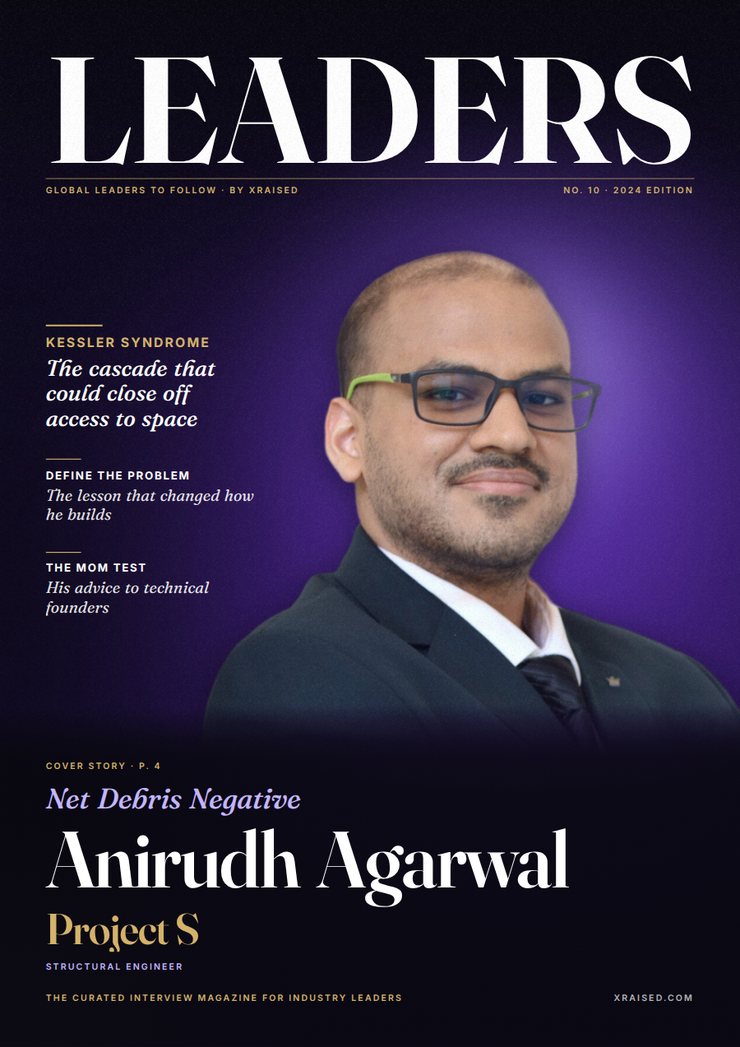
Anirudh Agarwal
Project S Structural EngineerNet Debris Negative
From food 3D printing to satellites, engineer Anirudh Agarwal has learned that the hardest part of building anything is defining the problem. Now he is applying that lesson to the debris circling Earth.
Everything humanity has launched into space that was not designed to come back down or burn up in the atmosphere is still up there. Anirudh Agarwal states it plainly: “Every satellite becomes debris at the end of its mission if it doesn’t de-orbit, not to mention everything that was launched that did not work or blew up.” It is the problem that now occupies him at Project S, an in-orbit debris detection startup in Munich, where he works as a structural engineer.
The path there began with a childhood ambition. “Since childhood, I used to say I wanted to be a scientist,” he told Xraised. By the time he went to IIT Roorkee for his bachelor’s degree, he already dreamed of mass-producing useful technologies to make them available and affordable for all. A course in manufacturing technology settled the question. “I instantly saw it as the thing I want to do with my life.” Along the way he sharpened the ambition: not to uncover fundamental principles, but to apply established ones to build something new. “I realized I actually always wanted to be an inventor.”
A master’s degree at the National University of Singapore, specialising in manufacturing technology and automation, followed. Singapore also introduced him to technopreneurship, which he describes as the perfect middle ground between pure academic work and the corporate world. “I get to build something highly technical while having a real-time and real-world impact on society.” Startups, he reasoned, could carry new technology to more people in a shorter time. He began networking at startup events, and a few years later he founded his first startup.
What followed was an unusually broad run of engineering: soft robotics, food 3D printing, 3D printing of magnetic materials and, finally, satellite manufacturing, always in interdisciplinary teams and almost always in research and new product prototyping. The lesson stayed constant. “When it comes to making useful products, the key is always the same: observe how other stakeholders engage with your products and adjust them accordingly.” When he saw colleagues manually editing gcode for embedded 3D printing, he wrote a script to generate clean gcode directly. When he demonstrated food 3D printing, he tailored the shapes to the audience: superheroes for children, and a yin and yang made with Western and Asian recipes for a Singaporean local news channel.
On satellites, the same instinct pushed him beyond his own discipline. Designing the mechanical side, he recognised how closely it depended on the other subsystems, and moved into systems engineering so that the structure could adapt to the changing landscape of components and constraints in the design process.
Project S applies that systems view to orbit itself. Every explosion or collision creates thousands of new pieces of debris, and the more pieces there are, the greater the chance of further collisions. Past a certain point, one collision produces enough debris to cause more, and the cascade grows exponentially until nothing new can be launched. This is Kessler Syndrome. The stakes on the ground, he insists, are concrete. GPS, the internet, satellite communications and broadcasts, environmental monitoring, weather forecasting, climate modelling and land-use tracking all depend on space. “It is the bedrock of our modern way of life.”
His framing borrows from the climate debate. “Just like down on earth, we must be net-carbon negative; in space, we must be net debris negative.” The freshly funded startup is developing space-based radar payloads, AI analytics and decision-support software to detect sub-centimetre debris and support collision avoidance for satellite operators. “We are in the early stages of this, so we are starting with detection at Project S and will gradually move towards reduction.”
The biggest change in his own thinking, though, concerns problems rather than solutions. “As an engineer at heart first and foremost, I hyper-fixated on the technology and solving a hard technical problem,” he admits. Education trains people to solve the problem statement they are given. Leadership asks for something harder. “However, as a leader, defining the problem well is the real objective.” Finding the through line that connects the technology, its technical and financial constraints, the suppliers and the customer’s problem is, in his view, the central task of any product developer or company leader. Once that is done, much of the solution can often be assembled from existing tools and talented specialists. “Once you give smart people a concrete problem, they can hyper-fixate and solve it.”
It is the point he returns to most often when talking with early-stage founders. Technical founders, he says, tend to fall into the same trap: they build a great product and then discover that no one wants it. He points them to Rob Fitzpatrick’s The Mom Test. “Don’t tell potential customers or other stakeholders about your solution. Ask them about their problems and how they perceive them.” How big is the problem? What are they doing about it now? How much effort or money have they already spent wrestling with it? The answers may point somewhere unexpected. “You may find that what you need to make is completely different from what you originally intended. But that’s ok. At least now you know what to solve.”
Nor is the exercise ever finished, because needs change and the questions have to keep being asked. For Agarwal, the work ahead at Project S starts where his advice does: with detection, with a clearly defined problem, and with the ambition he has carried since college, to make useful technology available and affordable for all.