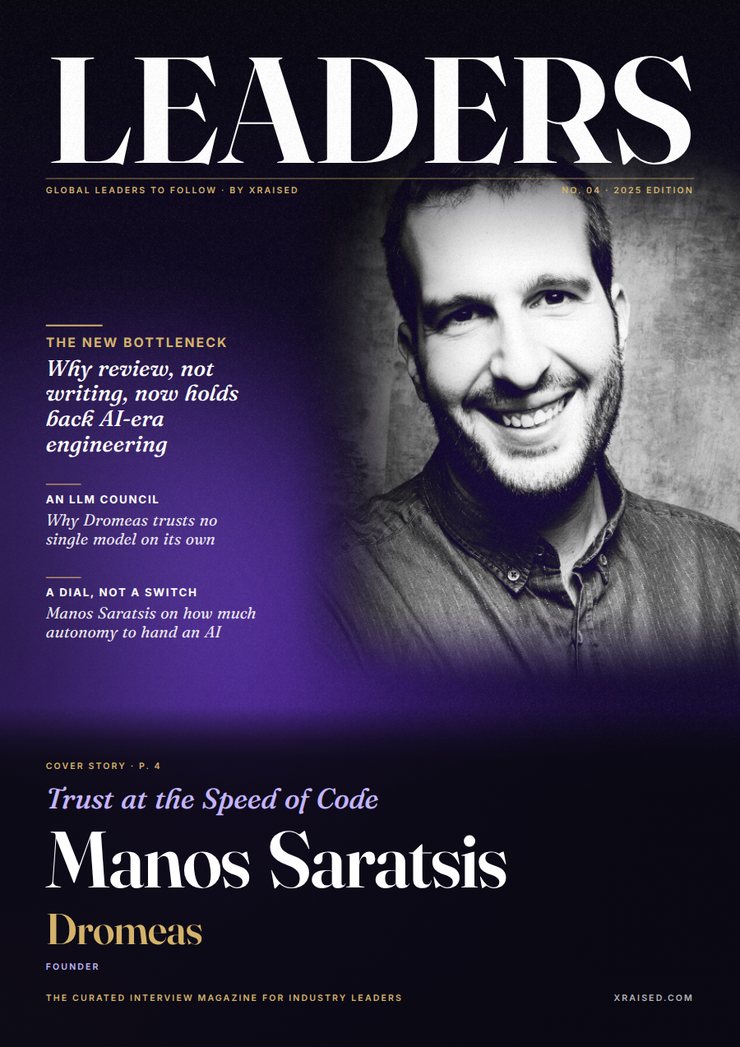
Manos Saratsis
Dromeas FounderTrust at the Speed of Code
AI made writing software fast. Manos Saratsis founded Dromeas because nothing made trusting that software any faster — and he believes closing that gap is what will separate the winners.
For a long time, the hard constraint in software was producing the code. AI coding tools changed that, but they moved the bottleneck rather than removing it. Manos Saratsis, founder of Dromeas, can say exactly where it went: to review, to verification, to trust. His founding insight fits in a single line: “The tooling that helped you write code faster didn’t help you trust it faster — that gap is what Dromeas fills.”
The consequence, as Saratsis describes it, is a trap many engineering teams will recognise. The volume of AI-generated diffs has outpaced the capacity of people to review them, and that leaves two options. Teams either rubber-stamp what lands in front of them and accept the hidden risk, or they slow back down to the pace they kept before AI. In his view, both are bad outcomes.
It is a problem he is well placed to see from more than one side. Before he became a product person, Saratsis was an engineer, holding multiple roles at Vodafone Group in Düsseldorf, where he led location services and the Opera Mini OEM integration programme. At Netdata he was Director of Product and, in his words, “got to do something rare: take a beloved open-source project and ship its first cloud product from scratch.” At Dynatrace he led the Behavioural domain in Digital Experience Monitoring, helping enterprises make sense of how users actually interact with their products.
Dromeas is what he is building now. Saratsis describes it as “an agentic pre-production workflow for engineering and security teams who can’t afford to let AI-generated code go straight to production unchecked.” Code quality, security, compliance, testing, instrumentation and documentation are orchestrated by AI, with support for multiple models by Anthropic and agents connected safely to GitHub through an MCP server. His starting premise is plain: “The next wave of software is being written by AI.” The winners, he believes, will be the teams that work out how to ship it fast and reliably.
So what changes for a developer once Dromeas is in the loop? Review stops being an event that happens only when a pull request is opened. PR review and trunk review run on every commit, so issues are caught earlier, before they compound. Instead of five disconnected tools or checklists for security, quality, compliance, tests and documentation, one review covers them together. And findings arrive with repair handles: not just a note that something is wrong, but a path to a fix, previewed before anything is applied. The aim is for review to keep pace with how fast AI lets a team generate code, instead of being the thing that throttles it.
The same thinking extends to the release itself. Saratsis argues for agentic release management, in which release readiness is no longer a manual checklist that someone owns and forgets to run. Security findings, failing checks, compliance issues and coverage gaps are consolidated into one verdict rather than scattered across dashboards. What he is after is a complete release: not merely one where the tests passed, but one in which security, quality, compliance and documentation have all been cleared together.
Underneath it all is context. Dromeas indexes every file and function into a live call graph, so before anyone touches a function they can see who calls it, what it calls and how far the blast radius reaches. Saratsis is clear about why that matters. AI-generated changes are dangerous precisely when they are made without context: a diff that is correct on its own terms can break a caller three layers away. The call graph, in his account, is what separates a tool that finds surface-level issues from one that understands a codebase like a senior engineer who has been there for years.
Trust is also why Dromeas does not lean on any single model. No model is trusted alone; an “LLM council” of models has to agree before something is surfaced as a real finding, which cuts the false positives that erode confidence in a tool. Nor are teams locked into one vendor. With bring-your-own-model, they can plug in the models they already trust or are governed to use.
The harder question is how much the system should be allowed to do on its own. Saratsis’s answer is that “autonomy is a dial, not a switch.” At one end, Dromeas surfaces findings for a human to approve; at the other, it applies the fix and opens the pull request. What makes the higher settings safe rather than reckless, he argues, are the guardrails beneath them: a verification loop, human approval gates and compliance checks.
It is a measured position for a founder building with AI, and it points to where he wants Dromeas to take its users: from prototype to production at the speed AI now allows, without letting unchecked code slip through. He summed up the philosophy in the closing line he offered for his Xraised episode: “The goal isn’t to replace engineering judgment — it’s to make sure judgment is only spent where it’s actually needed.”