
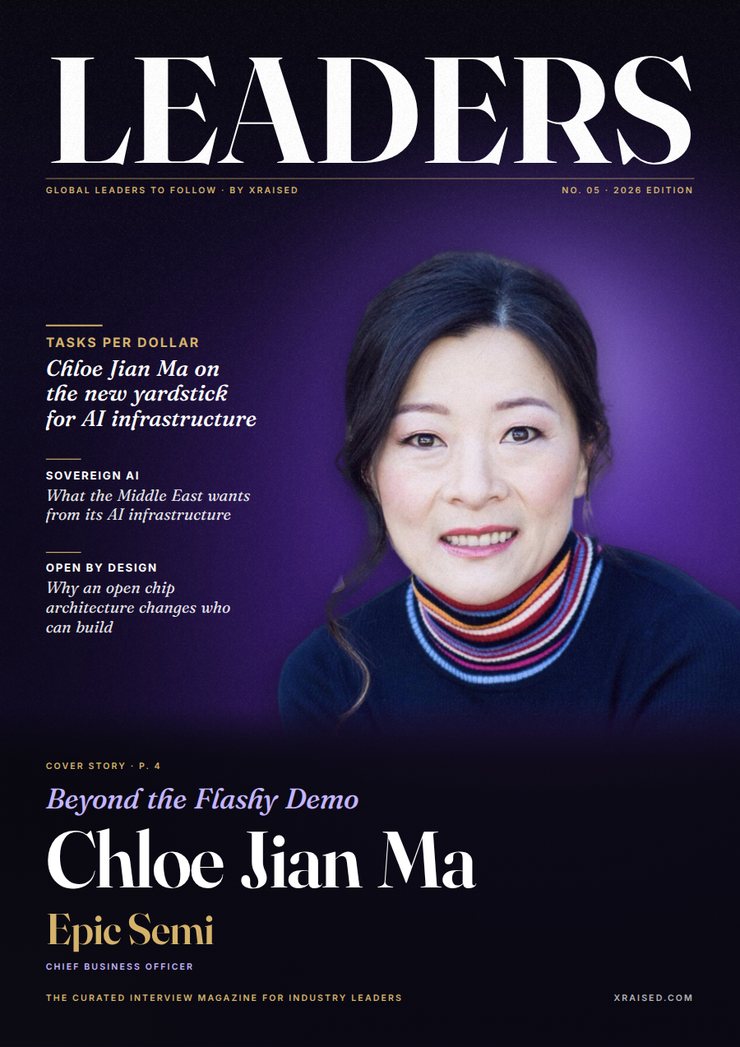
Chloe Jian Ma
Epic Semi Chief Business OfficerBeyond the Flashy Demo
Chloe Jian Ma’s career has tracked every shift in infrastructure, from networking to chips. At Epic Semi, she is focused on the next one: AI that does real work, on open hardware, under its owners’ control.
Over the summer, Chloe Jian Ma hired an intern, a college freshman, to build AI agents that would make her team’s marketing and sales more efficient. Building them was the easy part. “Now, with AI, it’s so easy to build something as a proof of concept,” she says. The harder question came next: “But once we have those agents, how do we actually keep them running reliably and integrate with our other work?”
That question sits at the centre of Ma’s work as Chief Business Officer at Epic Semi, which she joined around a year before speaking to Xraised. Agents, she points out, do not live on token generation alone. They still have to query a traditional database, open a PowerPoint or Word file and fit into existing business processes, with security and authentication guaranteed. GPUs cannot do that alone. The accelerators themselves are hard to deploy and manage, too, especially for IT teams that want to keep workloads on-premises. Those gaps, as she sees it, are what stop companies taking a flashy demo into production.
Her own career reads like a history of the infrastructure underneath. “My career has really followed the evolution of infrastructure,” she says. She started at the peak of the dot-com bubble, so naturally joined Cisco, the networking giant of the internet era, and then Juniper Networks. When she saw infrastructure leadership shift to Amazon Web Services, Google Cloud and Microsoft, and those hyperscalers begin dealing directly with chip makers, she followed, moving to Mellanox, a semiconductor chip and module company. An urge to understand new workloads, as machine learning emerged, took her into compute: first Intel, then SiFive, the Silicon Valley startup where she met Epic Semi’s founders. She went on to spend about four years at Arm, building edge AI solutions for semiconductor chip companies.
Epic Semi offered a chance to put all of that into one full-stack, end-to-end AI infrastructure offering. “AI is developing so fast, and people just don’t have time to look at every little chip, every component,” she says. Customers want a complete, deployment-ready system. She was equally drawn by the CEO’s vision of a larger mission: AI that is more sovereign, for nations and for enterprises that want to protect their core competency and their data. In Silicon Valley, she admits, “we live in an ivory tower”. The point is to help every industry and every nation build and deploy technology for their own benefit, under their own control.
Her view of what businesses will want next is clear-eyed. Raw computing power is not the point, and nor is the number of tokens a particular GPU can produce. What matters is the whole workload, solving a real business problem such as how to grow European sales. “It’s actually more about the number of successfully completed tasks per dollar of TCO,” she says. Businesses also want choice. “Nvidia is a great company, but if you only have this choice, many businesses would be a bit worried.”
Control is also what draws her to the Middle East and the GCC, a region where she had spent little time before joining Epic Semi. Many of Silicon Valley’s rising AI giants, she noticed, found early success there: “They all made their first bucket of gold in the Middle East region.” She sees a national ambition to become a significant player in AI infrastructure; abundant oil that can be turned into cheap electricity at a time when AI has raised fears of power shortages; and capital moving from US companies and real estate into AI data centres. Travelling there, she also saw a determination to protect culture and language, including by training Arabic language models.
Security concerns, sharpened by war in the region, add urgency. Ma describes three levels of sovereignty these nations want: over data and models, over infrastructure, and over operations. Buying GPUs and switches is not enough. They want to run that equipment themselves rather than rely completely on a third party.
Epic Semi’s answer is the Contrail AIX server CPU, built for what she calls the shift from the AI training era to the execution era. Her analogy is school: we go so that we can use the knowledge for our families and the wider world, and training the models was school. Now AI is entering its inference and agentic phase, and a single agent may need to open a PowerPoint, query a database and reason with a large language model in one task. So Contrail AIX puts traditional CPU processing and AI acceleration on one chip, with shared memory and storage, to make the handshake between them easy.
Just as important, it is built on RISC-V, an open architecture governed by a nonprofit in Switzerland, which she regards as about as neutral as it gets, rather than on the proprietary architectures that have traditionally run GPUs and CPUs. Any country or company with the talent, investment and desire can build on it. If Brazil, Malaysia or Germany wanted to build its own chip, Ma says, it could do so without changing the software on top. “So that’s the beauty of open architecture.”
Epic Semi is headquartered in the US and in Saudi Arabia, where its CEO moved from the US. For Ma, the next chapter of AI will be judged by work done rather than demos admired: agents that keep running, infrastructure that arrives complete, and nations and companies that stay in control of both. It is, fittingly, the next stage in the evolution of infrastructure her career has followed from the start.