
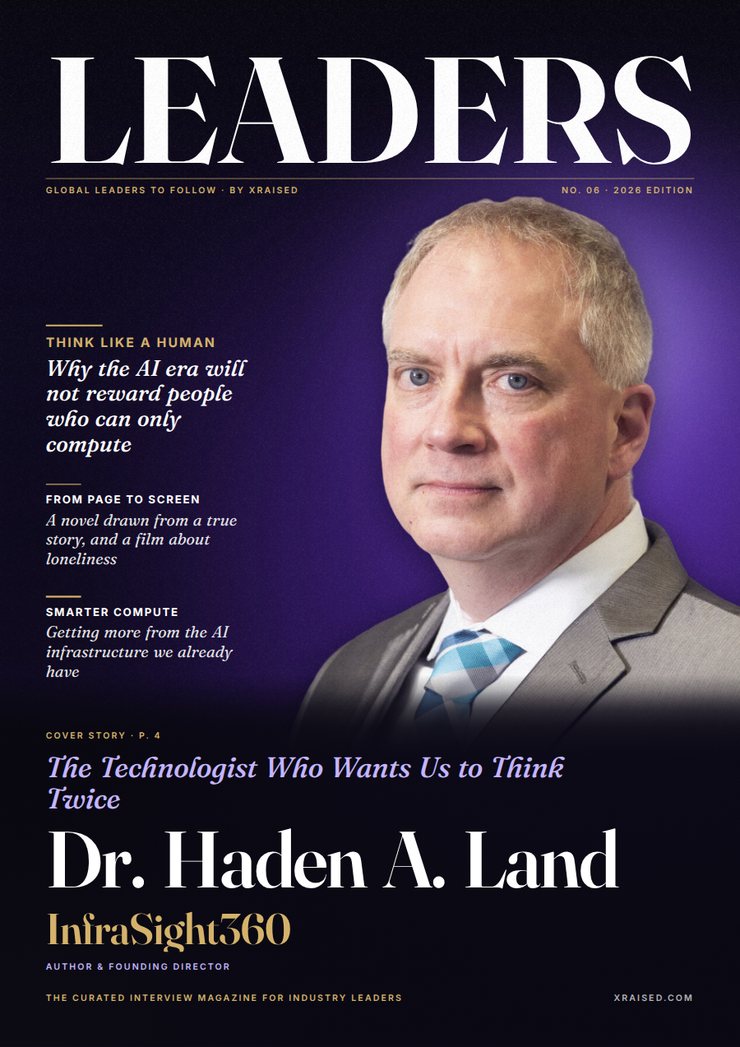
Dr. Haden A. Land
InfraSight360 Author & Founding DirectorThe Technologist Who Wants Us to Think Twice
Dr. Haden A. Land spent decades at the frontier of technology. Now an author, film producer and AI company director, he argues that the skill the machine age needs most is the one we have let go quiet.
Most people, Dr. Haden A. Land says, know him for being "a ones and zeroes guy". The record bears that out: degrees in mathematics and computer science, and a career that took in IBM and Loral before he retired from Lockheed Martin as Vice President of Research and Technology for its Information Systems & Global Solutions business. Less well known is that in college, alongside computer science, mathematics, chemistry and physics, he took acting, drawing and film production, and earned a minor in psychology.
Both strands are on show now. Since his first conversation with Xraised, the book he came to discuss has found its readers, a novel is nearing publication, a film he backs as executive producer is heading into production, and an AI company he helped incorporate has beta customers. Alongside it all, he has spent 35 years on academic boards across four universities, two of those periods as chairman.
The book is Think Twice: The Lost Half of Human Intelligence and How to Get It Back, and its argument starts with an uncomfortable observation. "For a generation, we have trained ourselves to think like machines," Land writes. We optimise, we analyse, we converge on the one right answer, and now the machines do it better than we can. Decades of education and early career experience, he argues, have prepared people for mostly controlled environments. "We are not trained well to meet a problem that has no definition yet."
The neuroscience is specific. The Central Executive Network, centred in the prefrontal cortex, activates when we focus, analyse, decide and plan; the Default Mode Network comes alive when we rest, daydream or take a relaxing walk. That second network, home to the divergent thinking that asks what else might be true, is the half we have let go quiet, and in Land's view our real remaining advantage: AI does not have a Default Mode and may never have one. "The AI era will not reward the people who can only compute," he writes. "It will reward the people who can explore and evaluate at once, and who know when to switch between the two."
For leaders, the shift he most wants remembered is the ability to lead and manage at the same time. Effective leaders, in his formulation, ask what and why; trained managers ask how and when; forward-thinking leaders ask all four, in the right situation and at the right time. While living in the United Kingdom he created a method called VIPER, for vision, influence, process, execution and responsibility, which the book sets out in Chapter 13.
Since the English edition appeared in July, the book has gathered 34 posted reviews on Amazon and Goodreads, many returning to its breadth and depth. One reader's verdict captures the intent neatly: "Made me actually think about how I think." The real surprise came from executive coaches. Land had offered the book for self-help, but two well-recognised coaches reached out and have since signed agreements to use it in their client programmes. "So that'd be the one that kind of caught me off guard," he says.
He had not meant to become an author until he officially retired, "for like the third time", which he expects to do next year. Seeing the AI explosion bear out his earlier predictions changed the timetable, and the author itch did the rest. His novel, tentatively titled Forever Sisters, is a murder mystery set within one family: fiction, but based on a true story. The subject is sensitive, so every person, place and timeframe carries a pseudonym, and a colleague who was part of the story co-authors it under a pen name. Land calls it somewhat of a project of closure for the family, and expected it on Amazon within weeks of the interview.
The film is where the other strand of his education resurfaces. "I'm a big advocate of STEM going to STEAM and adding creativity and arts and education and all that stuff," he says. The Absence of Violet, written and directed by Jack Jekirin and produced by Sean Patrick Burr, follows three misfits who receive letters from a friend who vanished seven years ago and have five days to find her. Land invested after hearing the director speak at a WeFunder event. Beneath the mystery lies loneliness, which he wants audiences to take seriously, citing figures that link chronic loneliness to a 29 per cent higher risk of heart disease and 50 per cent for dementia.
The newest venture returns to ones and zeroes. InfraSight360 was incorporated by three founding directors, Land among them in a predominantly financial role. With so much capital going into AI infrastructure, he argues, the industry should be asking not only how to build more compute but how to get more useful compute from what already exists. Rather than monitoring at the application or operating system level, InfraSight360 goes down to the micro-architectural level, connecting what an application does to the behaviour of CPUs, GPUs, memory, storage and network. The goal, in his words, is to make "the compute we already have work harder and more efficiently."
Ask him about the next decade and the answer circles back to Think Twice. Most people, he says, are not preparing adequately to succeed in the AI business environment. He predicts new careers born of blended convergent and divergent skills: quantum linguists, neuromorphic architects, roboticist counsellors, biomimicry analysts. The novel, the film and the company are all still in motion. In each, Land is making the same case: that the future belongs to people who use both halves of their intelligence.