
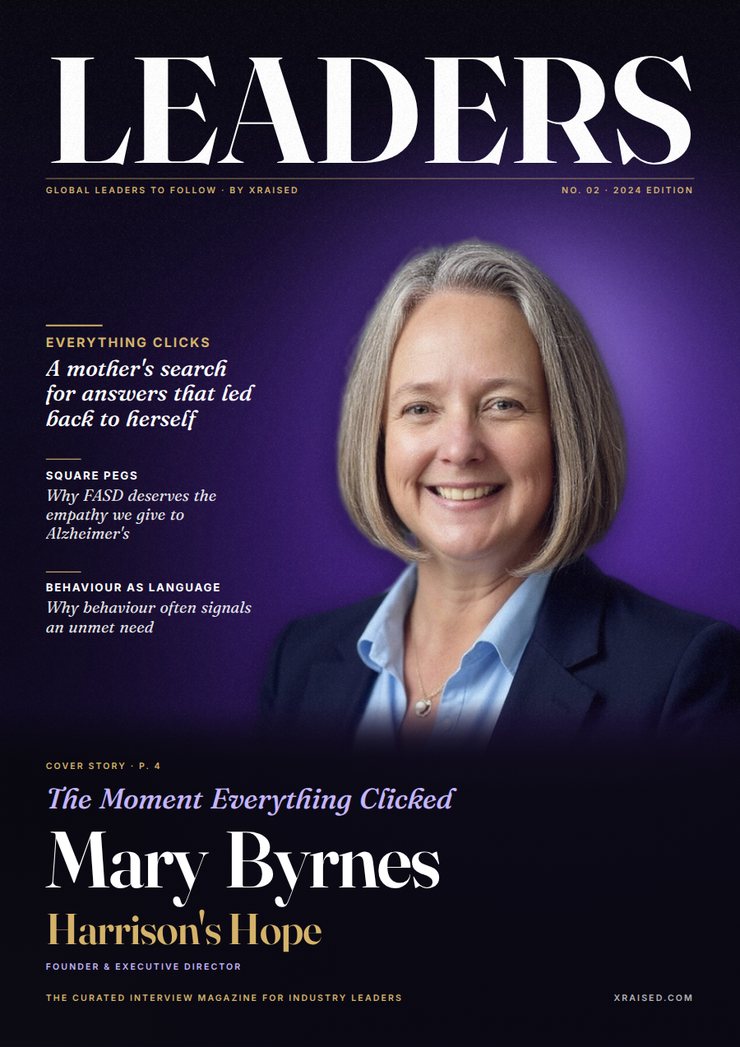
Mary Byrnes
Harrison's Hope Founder & Executive DirectorThe Moment Everything Clicked
Learning how to support her adopted son, Mary Byrnes kept recognising herself in what she learned about FASD. Today she runs Harrison's Hope and asks the world to meet people where they are.
On the online coaching calls, some of the other caregivers were still scratching their heads. Mary Byrnes was not. As the coaches gave examples of how fetal alcohol spectrum disorder shows up, she matched them to her own son, and they landed with her more deeply than they seemed to for some of her fellow caregivers. The hyper-fixation, the difficulty of breaking away from things: she understood where her son was coming from. And again and again she caught herself thinking: “wow, that's just like me.”
Those moments gave her book its title, and in time led to a diagnosis of her own. “I kept having them over and over and over and over and over,” she says. She knew that the facial features associated with FASD are present in only 9% of the population with the disorder, yet she noticed her own thin upper lip and flat philtrum. Conversations with her mother, then in her 90s, set her on the path from suspecting to knowing, and then to a formal diagnosis. “And my gut was right.” Her advice to anyone in a similar position is plain: “If you're onto something, follow it.”
The journey began with her son. Byrnes and her husband were, as she puts it, very lucky to adopt a baby boy as a newborn. Even with her own background in special education, there were bumps in the road, and several misdiagnoses before the family landed on the correct one: FASD. In learning how best to support him, she immersed herself in learning about the disorder, and found that it lit a fire in her, not only to help her own child but to help other caregivers have better days. “It instantly became my life passion to improve the outcomes for all families living with FASD.”
Along the way she discovered that she enjoyed speaking publicly, and she began to put the pieces together about herself. That path led her to create Harrison's Hope, the registered Canadian charity she now leads as founder and executive director. It supports families and children living with FASD through education, mentorship and community programmes, with a continuum of services that starts with prevention education and extends to senior care.
Her book, Everything Clicks: A Story of FASD, Motherhood, and the Life I Didn't Know I Was Living, could have been clinical or educational. She chose to make it personal. “For me, it's about being an open book and being transparent.” Talking openly about taboo subjects, FASD among them, is in her view the best way to reduce stigma, and she describes a tremendous amount of it, faced both by those living with the disability and by the caregivers who love them. She does not soften the reality. “It is the most complex caregiving you'll ever do.” But she is just as firm about what is possible: “With the right supports and the right accommodations, we don't just survive, we thrive.” If her story helps even one family better understand and support their child, she says, the book has done its job.
To explain life with FASD to people who have never encountered it, Byrnes describes society, and the communities, groups and organisations we belong to, as a world full of round holes. People living with FASD tend to be square pegs. “You don't fit at school. You don't fit at work.” The result, she says, can be a lifetime of exhaustion, unaddressed trauma and severe mental health issues, for individuals and their caregivers alike. Part of the difficulty is that the disability is invisible. “Just because you cannot see our disability, doesn’t mean it doesn’t exist.”
Her most persuasive argument borrows from a condition most people already understand. We know that Alzheimer's is a degeneration of the brain, she says. So if Aunt Bertha belts out her top 10 swear words in church, the community gathers round the family with empathy and compassion, because it is not her choice; it is the illness. Byrnes wants the same response extended to anyone living with a neurodiverse disability, including FASD, once people have the correct information.
The need for that understanding is not small. FASD is difficult to diagnose and often goes undetected, so its prevalence is hard to pin down, but current studies suggest up to 4% of individuals in Canada are living with it.
What she hopes readers carry away from Everything Clicks, whether they are parents, professionals or simply curious, is a willingness to meet people where they are, and to recognise that behaviours are often the communication of an unmet need. They are not a reflection of the person, she says, but of the symptoms of a disability you cannot see. Her prescription is short. “So be inquisitive, be kind, connect, be willing to include.” As she puts it: “It's that simple.”
Byrnes hopes Everything Clicks will be the first book of many, and that it carries a belief in a positive future for other families living with FASD. For a story that began with quiet realisations on coaching calls, it is a fitting next chapter, and one that may give many more families their own moment when everything clicks.