
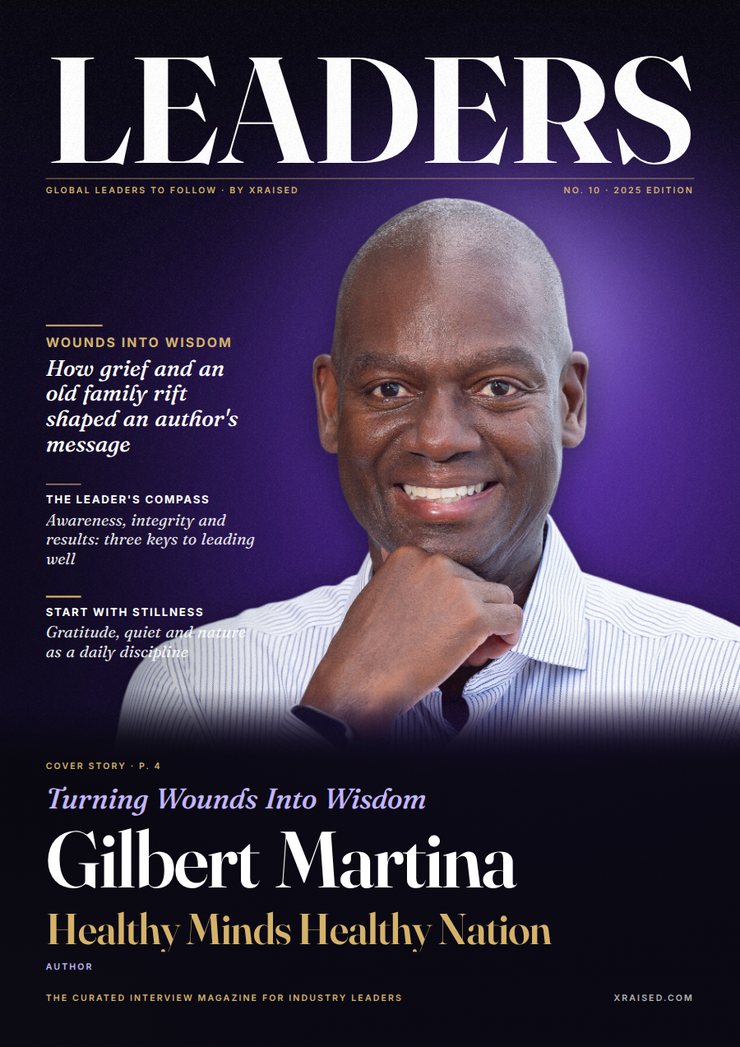
Gilbert Martina
Healthy Minds Healthy Nation AuthorTurning Wounds Into Wisdom
Months after his father died, Gilbert Martina began writing Healthy Minds, Healthy Nation. His argument: heal the individual, and you begin to heal relationships, communities and, in time, a nation.
On a Sunday in May 2023, over lunch with his family, Gilbert Martina turned to his wife, whom he calls his queen, and told her: “I'm going to write the table of contents for a book that just came to me.” His father had died that February; six months after his passing, his mother died too. The book that grew out of that year, Healthy Minds, Healthy Nation, is about what loss, and older wounds, can teach us.
The title was not new. Martina had used it six years earlier for a keynote he gave as managing director of the largest insurance company on the island, arguing that people more aware of their health and of preventive care could save costs for themselves, the community and the insurer. The book takes the phrase somewhere far more personal. Its core message is that when we heal the individual we can transform relationships and strengthen communities, which in turn influence societies and the world.
The book addresses grief directly. “Healing means that we can turn our wounds into sources of wisdom,” he says. His parents have left the world in physical form, he believes, but they are everywhere in spiritual form, and that gives him and his family strength.
The deeper wound is older. Martina's father was his best friend. From him he learned cooking, music, dancing and astrology, and all the knowledge and wisdom of the island's countryside. Then, when Martina was 13, his father came home one night and, during a discussion with his mother, slapped her across the face. He cried for hours. His mother said she would divorce his father, and the family broke apart. “So my whole world collapsed.”
At 16 he went to study in the Netherlands. For almost three decades he could not speak to his father in a normal way; he compares the relationship to a glass that was once perfect, then fell and broke into pieces. The turning point came far from home, at a meeting with shamans in the Amazon. One of them, a man Martina had never spoken to before, told him: “Gilbert, I see a very dense energy on your heart chakra. Tell me about your father.” It had to be healed, the shaman said, and that healing opened Martina to his father again.
What the pain finally taught him, he says, was forgiveness: forgiving his father for the slap and for breaking up the marriage and the family. When you forgive someone, he explains, “you literally open the gate and let all that energy leave your system.” He has a homely metaphor for hardship. “When you squeeze a lemon, you get lemon juice. When you squeeze an orange, you get orange juice.” When life squeezes us, he argues, it is not to hurt us but to bring out a better version of ourselves.
The practices he recommends to newcomers are simple, and he lives them himself. He and his wife begin every morning with gratitude, because “being aware of what you have instead of complaining is one of the most powerful things you can do on a daily basis.” The second practice is stillness, for minds that are always busy reacting to the senses and to an overload of information. Beginners need no technique: sit somewhere quiet, close your eyes and notice what is happening in your body and your thoughts. The mind, he says, is like an ocean, active at the surface and calm in its depths. The third practice is time in nature, a reminder that we are connected to everything. “We are not human beings searching for a spiritual experience, but we are spiritual beings immersed in a human body.”
Healing, for Martina, also means looking back beyond our own lives. In his region, he notes, transatlantic slavery had a huge impact on societies. “Being aware of your past is key to the future.” He calls the work ancestral healing, and defines it as “making peace with the past to free the present and the future.” What we carry from parents, grandparents and earlier generations shapes how we think, act and see the world. If you want to change your life, he says, change your glasses, and learn to see what you inherited not as punishment but as gifts that can become sources of wisdom.
He brings the same thinking to leadership, where he identifies three components. The first is awareness. Leaders have traditionally been trained in business decisions, but in a turbulent world, he argues, “understanding human behavior is key for a leader.” That means knowing yourself and having empathy for the people you lead; without it, you miss every signal and every conflict looming around you. The second is integrity, which he calls our compass, because “without integrity, there is nothing.” The sun rises in the east and sets in the west wherever you are, he observes; our choices should be as constant, not swinging left or right with whatever is at stake. The third is results. A leader with fine words and a strong moral compass who does not deliver, he warns, will be bitten by it in the end.
Martina is now carrying the message beyond the book. He has started publishing articles on Substack, and through his website he is building what he describes as a movement for creating healthy minds that will lead to healthy nations. It is an ambitious arc for a book that began as a table of contents over Sunday lunch, but it follows the logic he has lived: heal one person first, and the rest can follow.