
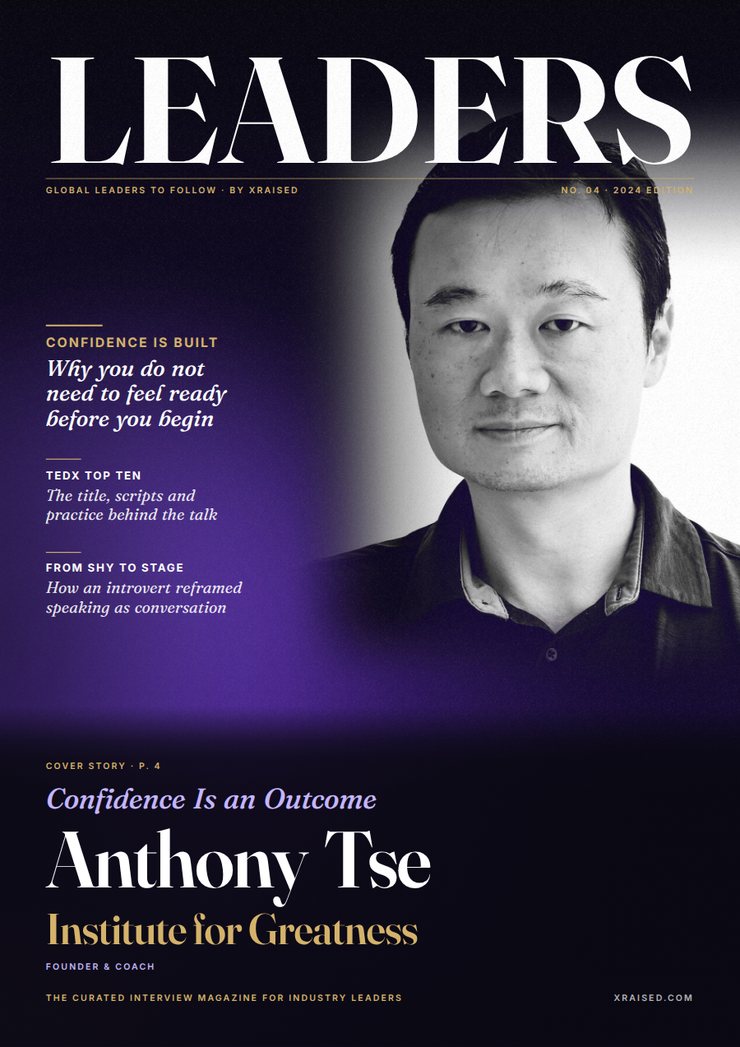
Anthony Tse
Institute for Greatness Founder & CoachConfidence Is an Outcome
As a young immigrant who could not yet speak English, Anthony Tse found the stage traumatic. Today his TEDx talk ranks among the top 10 published in the first half of 2026, and he insists confidence can be built.
The first time Anthony Tse had to speak on a stage was in his first year after immigrating to the United States. He could not yet speak English, and he was asked to play an American hero, in English. “I have no clue how to do this,” he remembers thinking. Public speaking, he says, became a traumatic experience. But he was determined: “I didn't want that to define me.”
It did not. Tse is now the founder and coach of the Institute for Greatness, a career transformation and executive leadership coach, an author and a global investor. He has written about that childhood fear in his book, The Glass Ceiling. And his TEDx talk, What Death Taught Me About My Career, has passed a million views and ranks among the top 10 TEDx talks published between January and June 2026. In his 16th Xraised episode, he retraced the road between those two stages.
He resists the idea of a single breakthrough. “I would say there's no turning point, to be honest, because everything's a journey.” Like many people, he found that his work required him to speak anyway. When he started his preschool, he presented to parents and ran seminars on how to raise children and why they should choose his school: public speaking in all but name. After selling that business to another education group, he entered a season of life in which he was looking for impact and significance, and speaking proved one of the most effective ways to achieve it.
Along the way he reframed what speaking meant. It became a series of conversations, from one to one, to one to a few, and then to one to many. Why repeat the same message 100 times one-on-one, he reasoned, when he could deliver it once to 100 people? He also came to see that many celebrities are introverts who become different people on screen, and he was coached to do the same as a speaker. “So all this can actually be trained and taught.” Progress came in building blocks. “It's like Lego.”
The biggest thing he had to unlearn was the role of confidence. He opens the subject with a line popularised by Jerry Seinfeld: at a funeral, most people would rather be in the casket than giving the eulogy. Many people believe they need confidence before they can speak. He sees it the other way round. “Confidence is an outcome, not a cause.” It can be built, he says, “just like a muscle.” With clients, he starts with what they can already do: breathe slowly, encourage themselves, watch themselves on video, look in a mirror. It may feel awkward, but it is possible. Practise, repeat, and confidence follows.
He also strips the grandeur from the label of public speaker. Chatting with friends about a topic you know needs no special confidence; add a few strangers at dinner and most people are still fine. A speech is the same thing, amplified. So study your audience before you speak, and choose a topic you are comfortable with. Confidence, in the end, depends on how well you know both your listeners and your content.
When he learned of the ranking, he went looking for what it meant. By his account, only 2% to 3% of TEDx talks reach around 10,000 views, and fewer than 0.02% pass a million. No single element, he insists, explains the reach of the talk, which draws on how he survived two near-death experiences. The title mattered: he and his public speaking coach spent a long time on a combination of words, death and career, that would stand out online. The topic was relatable, and the story was personal. Then came delivery. He had rehearsed it in four-minute and six-minute versions, before different audiences and judges, and spent months on the script. “In many ways, it's a movie production.”
Speaking has also changed how he sees his own story. He never expected it to resonate with so many people, or to move them to act. “Everybody has a story to share,” he says, and he does not think his own is unusual. “I'm just an ordinary bloke.” The difference, he believes, is a willingness to share it. After one talk about buying and selling businesses, someone came back to him and said: “Anthony, I bought a business listening to you speak for 60 minutes.” That person had walked in with no intention of buying a business. “That is one of the most fulfilling things I've ever achieved in life,” Tse says. It was not about the money or the titles.
His advice to anyone talented but afraid to step forward begins with finding a coach, because many speakers, and many coaches, started as ordinary people. Then lower the bar. “Speaking may not be for everybody today. But what's important is that sharing is.” Share your story with small groups, write a blog or a post, perhaps eventually a book. Stepping into a bigger role, he says, is about influencing one person, then two, then three, not about titles. And when the doubts arrive, remember the arithmetic: “there are a hundred reasons to say no, but all you need is that one yes.”
Nor, he insists, do you need to be the best. Being ordinary and grounded makes a speaker more relatable, not less. This season of his life is about impact and significance, and the message he wants every audience to leave with is the one his own journey taught him: if he can do it, so can they.