
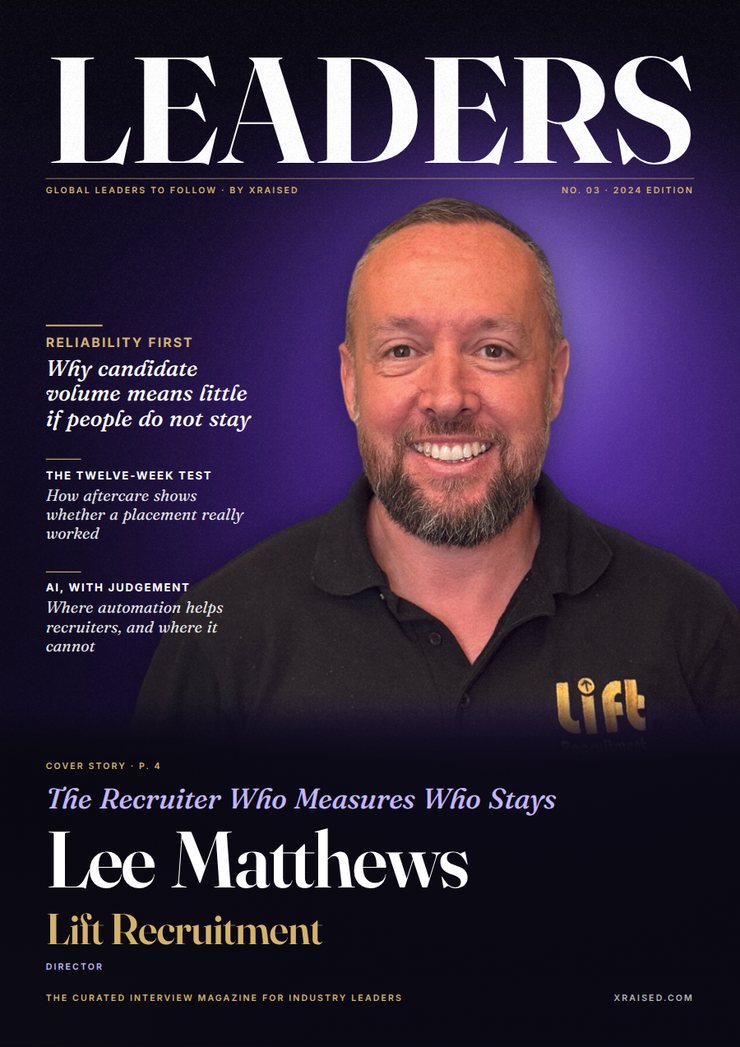
Lee Matthews
Lift Recruitment DirectorThe Recruiter Who Measures Who Stays
For Lee Matthews of Lift Recruitment, a list of hundreds of candidates means little if few of them turn up and stay. In warehouse and logistics hiring, he argues, reliability is what counts.
One of Lift Recruitment's clients had a problem with its afternoon shift. Turnover was significant, and it kept recurring. The obvious response for a recruitment agency would have been to keep sending more candidates into the same conditions. Lee Matthews and his team did something slower. They set out to understand what the shift actually required, and the transport challenges that came with it. By working through those factors, they gradually helped stabilise the staffing and improve the operation.
For Matthews, the episode captures his whole approach. Lift Recruitment, the UK-based agency he co-directs, supplies temporary and permanent workers to the warehouse, industrial, automotive and driving sectors, with a particular focus on warehouse, logistics and transport. His background in business shaped its philosophy from the outset: recruitment is an ongoing operational process, not a numbers game. An agency, in his view, should act as an operational partner rather than simply a supplier, because when a client is struggling with high turnover or a difficult shift, the problem rarely has a single cause.
The central flaw in volume-led recruitment, as he sees it, is simple. Having hundreds of candidates available means little if only a small percentage actually turn up and stay. What drives reliable attendance is the right combination of person, job, location, pay and shift pattern, and in warehouse and logistics work, reliability has a direct impact on how an operation performs. Small, practical mismatches matter. Something as ordinary as transport or shift timing can be enough to make a worker leave within days of starting.
That is why Matthews does not rely on job descriptions alone. His team spends time with managers and with the people working on the shop floor to understand the reality of a role: the working conditions, the hours, the journey to work and the type of person most likely to succeed there. That kind of insight cannot be gathered from a brief. It comes from direct engagement with the workplace.
Nor does the work stop once someone starts. Lift Recruitment follows up with workers after their first day, after their first week and through the weeks that follow. Matthews regards reaching the 12-week point as an important sign that the recruitment was done correctly. Staying in touch allows the team to spot problems early, before they become absences and disruption. For him, recruitment does not end with placement; ongoing communication and aftercare, with candidates and clients alike, are what build a more reliable workforce.
When people do leave, he wants to know why. The agency conducts exit interviews to understand what went wrong: whether the role was misrepresented, transport was a problem, the shift was unsuitable, or something else affected retention. Those answers feed back into future placements, so that each match is better informed than the last. It is the same patient logic that steadied that afternoon shift.
Matthews is no sceptic about technology. He sees strong potential for AI in CRM systems, administration and candidate filtering, areas where automation can save time and bring consistency. But he is clear about its limits. A conversation with a candidate reveals things that an automated system or a CV may never capture: personality, motivation, communication and the smaller nuances that decide whether someone will thrive in a role. AI can make recruitment more streamlined, in his view, but the human element of judgement, relationships and personal follow-up will remain fundamental.
His advice to businesses that want stronger, more reliable teams without more headaches follows from all of this. Understand the real working environment, not just the job description. Choose a recruitment partner who asks the right questions, follows up after placement and treats retention as a shared responsibility. And when workers leave, find out why, because the answer often holds the information that stops the same problem recurring. The goal, as Matthews frames it, is not simply to fill a vacancy but to find the right person for the right environment, and to support that relationship so it lasts.