
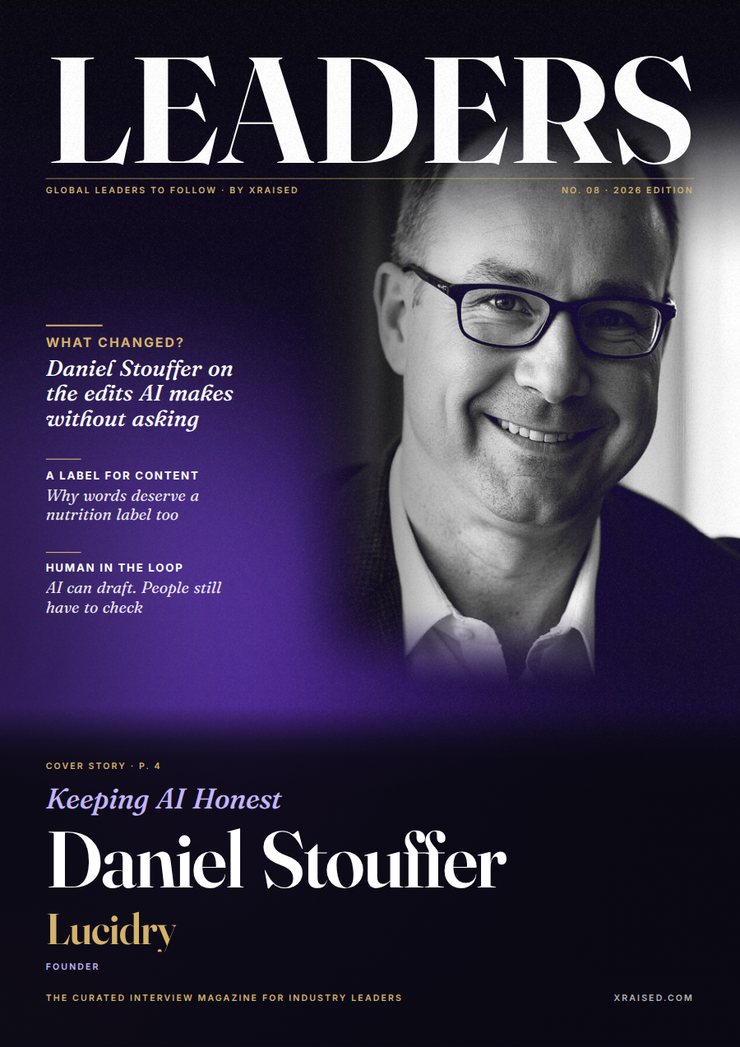
Daniel Stouffer
Lucidry FounderKeeping AI Honest
Daniel Stouffer noticed that AI does not only write generic copy. It quietly changes names, numbers and meaning. With Lucidry, he is building a way to see exactly what changed, and why.
Imagine a draft that records 4.5 million dollars of revenue for the year. Put it through an AI editor, says Daniel Stouffer, and the figure could come back as 4.6, or as 400, with nothing to tell you it has changed. “Some people call it hallucination but it’s more than that,” he says. “It’s more important than that.”
Stouffer, the founder and growth hacker behind Lucidry, has worked in the content space for a while, long enough to watch AI flood it with what has become known as AI slop: content so generic that it all looks the same and sounds the same. His first idea was an engine that could turn the raw material of interviews, the transcripts, conversations and notes, into usable content. But the deeper he dug into the problem, the clearer it became that generation was not the real issue. The real issue was what AI does to your words when you ask it to make them better. It changes them.
His diagnosis of how most people use AI is blunt. We are using it as a crutch, he says, letting it do the creative work of finding a unique angle or a story worth telling. AI “is good for us to produce a draft”, in his view, but not a finished product. His answer is to keep a human in the loop: people write the outlines, AI helps with the drafts, and a human editor refines the result. Along the way, though, the names, facts and citations to source material all have to survive, and often they do not.
The risk is not only a wrong number. A name can change. A sentence can be rephrased so that it sounds better but loses the voice or the data it contained. Most people, he argues, simply hand their text to AI and accept that what comes back is correct. In some fields, that is far more than an embarrassment. Think of legal content, he says, or medical content. “If you change numbers in a medical document, that’s catastrophic.”
Lucidry’s response is an audit trail. Its Lucid Report scores a piece of content on five dimensions in an auditable way, and Stouffer reaches for a familiar comparison: the nutrition label on food packaging, a standard breakdown that travels with the product. “Human sounding is one dimension,” he says, and only one. Behind the report sit nine algorithms, covering tasks such as filtering, maintaining data and facts, adding voice and professional editing, the checks a professional copywriter would run through in their head. In his example, a raw transcript scores 60 out of 100 and the finished piece 98, and the report shows what stayed, what changed and why.
Broadly, he says, “anybody that cares about words can use my product”. In practice he has particular readers in mind: ghostwriters producing thought leadership in a chief executive’s voice; agencies writing press releases, white papers and case studies, where the data must stay exact; lawyers and journalists. He describes a witness statement taken down by a police officer, transcribed, and carried all the way to court. If it changed along the way, “you need to know that.”
The danger grows as a draft passes through more hands. One person edits it, then another, then AI supplements it, then someone else edits it again. “AI could have just destroyed all of those facts and you wouldn’t even know,” he says. He also sees a place for Lucidry inside other software. Social media posting apps offer to send a brand’s messages across the internet at speed; placed between the client’s original idea and the post, Lucidry could check that what goes out is what the client actually said. As an API, the idea is simple. “You ask my API for value. I give you value.”
For now, his biggest challenge is awareness. The concept takes a moment to land, he admits; people need to scratch their chins and think it through. One illustration he offers is a figure of 49.97 that AI quietly rounds up, because “50 sounds better than 49.97.” No tool, he says, tells you that it changed. So he is making the case in public, through thought leadership, articles and interviews like his conversation with Xraised.
For Stouffer, the next chapter of AI in content is not about producing more of it. It is about being able to trust what is produced. “It can look pretty, but it also has to be accurate.” Right now, he believes, accuracy is exactly what goes missing when we hand our content to AI. Lucidry is his attempt to put it back.