
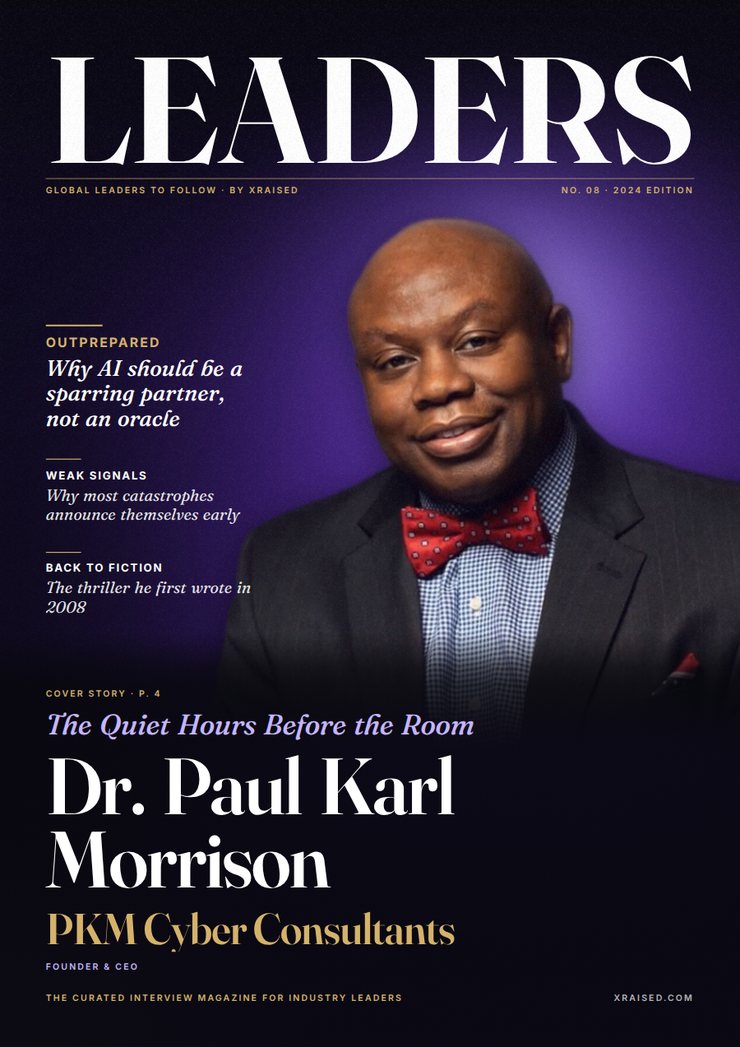
Dr. Paul Karl Morrison
PKM Cyber Consultants Founder & CEOThe Quiet Hours Before the Room
Cybersecurity executive, author and veteran Dr. Paul Karl Morrison on AI as a rehearsal partner, the weak signals leaders ignore, and the novel that took him back to fiction.
On the morning of September 11, 2001, a woman named Janice runs barefoot across the Brooklyn Bridge while lower Manhattan burns behind her. She survives and rebuilds. Six years later, her husband surprises her with a trip to Colombia, and it feels less like love than a verdict. Dr. Paul Karl Morrison has spent most of his career writing about threats that arrive from outside. His novel, The Woman in the White Sheets, is about one that was already in the house. “What kept pulling me back to Janice was that her danger did not arrive,” he told Xraised. “It was already there, sitting across the breakfast table, wearing a familiar face.”
Morrison, founder and chief executive of PKM Cyber Consultants, has built his professional life around a different kind of danger. A U.S. military veteran whose career spans more than two decades across information security, artificial intelligence and strategic leadership, he serves as a Regional Chief Information Security Officer, translating complex risk into frameworks that executives and boards can act on. He holds a Doctor of Science in Computer Science and a Master of Science in Artificial Intelligence.
He traces all of it to a single instinct. “I have always been drawn to protecting things that matter,” he says. Military service gave him discipline, mission focus and the understanding that the people around you are counting on you to do your job with precision. Cybersecurity carried the same sense of mission: protecting systems, data and people who may never know your name. AI followed as the threat landscape began to outpace human defenders.
That conviction produced AI & Cyber Security: A Game Changer, the subject of his first Xraised conversation. The moment that crystallised it was a case in which fraudsters used an AI-generated voice to impersonate a CEO and authorise a wire transfer. “One phone call. One convincing voice. Hundreds of thousands of dollars gone.” For businesses, the conclusion is blunt: “Security is no longer a product you purchase. It is a capability you build, maintain, and continuously evolve.” He is just as firm about ethics. “Technical competence without ethical reflection is insufficient.”
His next book turned the same rigour on people. OUTPREPARED: How AI Makes You the Smartest Person in the Room grew, he says, from watching brilliant people walk into important rooms underprepared, not for want of effort but for lack of time. In cybersecurity, he notes, the entire discipline rests on a simple truth. “You do not rise to the occasion. You fall to the level of your preparation.” So when he looked at AI, he did not see a shortcut. “I saw a rehearsal partner.”
The gap, in his experience, is almost never the content. People prepare what they want to say and neglect what they will be asked. “They rehearse the pitch and skip the pushback.” His remedy is simple. In the hostile rehearsal, AI interrogates him as the toughest person in the room. In the pre-mortem, it imagines the meeting has already gone badly and explains why. In compression, it helps him say the same thing in half the words, because under pressure, as he puts it, clarity is mercy.
What he will not accept is AI as a substitute for thought. “So I teach people to use AI as a sparring partner, not an oracle.” You tell it what you think and ask it to find the holes; you ask it to argue the other side. “AI should make you a better thinker, not a lazier one.” Underneath the technique sits a conviction drawn from his faith: preparation is a form of respect, and a kind of stewardship of the opportunity in front of you. “The tools are new. That principle is very old.”
The novel, first written in 2008 under a different title and now fully reimagined, is where those threads meet. He admits he was not ready to tell Janice’s story properly the first time. Years of watching capable people miss the obvious, because seeing it was inconvenient or costly, changed that. He came back with more patience, stopped trying to make her clever and started trying to make her honest. The slow build of suspicion, he says, was the entire architecture of the book: a door that is suddenly locked when it never was before, an explanation that leaves her standing in the kitchen ten minutes later, still turning it over. “Janice is not slow. She is loyal, and loyalty is expensive.”
To Morrison, a woman reading the signs at home and an organisation reading them in its networks are practising “the same discipline, just in different clothing.” Most catastrophes, he argues, announce themselves well in advance and are ignored because the signal is inconvenient, ambiguous or embarrassing to raise. “In my professional work I tell executives that a weak signal is still a signal and deserves investigation rather than dismissal.” In the novel, he wanted to show what it costs a person to learn that the hard way.
Morrison lives on the Eastern Shore of Maryland, mentors the next generation of cybersecurity professionals and is pursuing a calling to teach. Whether he is writing for security leaders or about a marriage, the message is the same: the decisive work happens before the moment arrives. “The confidence people admire in the room is almost always built in the quiet hours before the room, when no one was watching.” And for those who seem to be managing quietly, he offers something closer to a tribute. “Ordinary endurance is the most underrated form of courage I know, and I wrote an entire novel to make that case.”