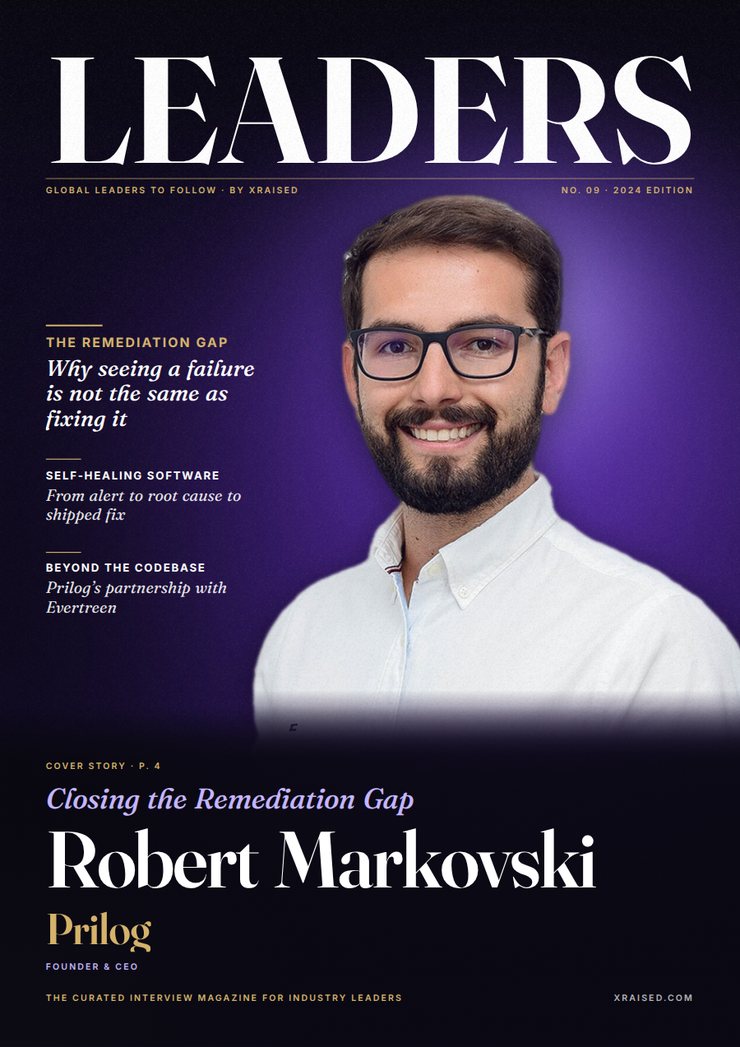
Robert Markovski
Prilog Founder & CEOClosing the Remediation Gap
Robert Markovski watched engineering teams see every failure in real time and still fix it by hand. With Prilog, he is building the layer that turns production problems into reviewable fixes.
“We can watch our production systems fail in real time, every log ingested, every trace correlated, every anomaly surfaced on a beautiful dashboard.” That is how Robert Markovski describes the state of modern software operations. Then comes the catch: “And then we page a senior engineer at 2am to go fix it by hand.”
Markovski, the founder and chief executive of Prilog, has a name for that distance between knowing and fixing. He calls it the remediation gap, and in his words “it's quietly draining engineering teams of their most valuable resources: the time and focus of their best people.” Closing it is the reason Prilog exists.
His quarrel is not with monitoring. “The observability industry is extraordinary,” he says. What teams still cannot do, without a person stepping in, is repair what they see. “Engineering teams don't have a visibility problem. They have a remediation problem.”
The conviction comes from experience. Before Prilog, Markovski founded mozok, where he learned what it takes to run production systems at scale, and how much engineering capacity quietly disappears into repetitive firefighting. “That experience is what made the remediation gap impossible to ignore.”
Prilog is an AI-powered software maintenance agent that sits on top of the observability tools teams already use, from Datadog, Grafana and Prometheus to SigNoz, CloudWatch and ELK, across AWS, GCP and Azure. It ingests logs, alerts and incidents, clusters recurring issues, maps them to the responsible code and generates reviewable pull requests. The work runs in three stages. It detects, grouping noisy logs and traces into the incidents worth addressing. It maps, pinning down the repository, service, deployment and function behind each one. And it fixes, drafting a patch and opening it as a pull request for a human engineer to approve and ship.
Markovski is precise about what Prilog is not. “Not another dashboard. Not another alert. Not generic AI code generation. The missing remediation layer.” A general-purpose AI model can produce a patch from a prompt, but it knows nothing of a team’s production history, dependencies or review habits. Prilog is built around that context, through what the company calls a Production Remediation Graph: a continuously updated model linking incidents, repositories, service dependencies, review feedback and recurrence history. The aim is a system that learns how each team’s software fails, how its engineers review code and which fixes survive deployment. Prilog does not train shared foundation models on customer data.
The company’s sense of responsibility reaches beyond the codebase. Prilog has partnered with Evertreen, a digital reforestation platform through which businesses sponsor tree-planting projects. Evertreen works with local farmers and forestry experts and tracks each tree with GPS coordinates and satellite monitoring. Markovski sees the collaboration as a deliberate choice about the kind of company Prilog is becoming, and its emphasis on results that can be verified mirrors the way Prilog treats its own work, where every fix is open to review.
The ambition behind all of it is plainly stated: a world without software bugs. Markovski believes the next decade of software will be built around remediation, not just visibility, with production systems that learn from their own failures and close issues before they consume another engineer’s weekend. As he puts it: “It’s time for software to heal itself.”