
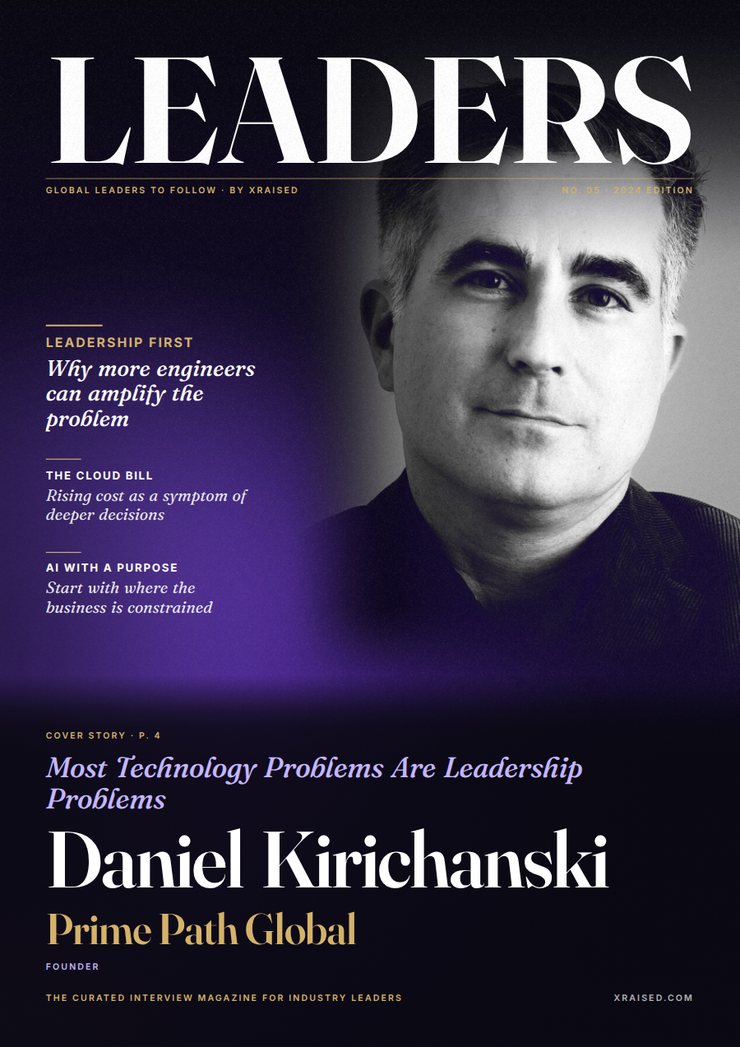
Daniel Kirichanski
Prime Path Global FounderMost Technology Problems Are Leadership Problems
Daniel Kirichanski spent more than two decades in technology leadership before founding Prime Path Global. His conviction: before you add engineers, platforms or AI, get the leadership aligned.
Picture a company that has grown quickly. Delivery has slowed, reliability has started to slip, the cloud bill keeps climbing and the engineering teams are frustrated. The obvious answers present themselves at once: hire more engineers, adopt another platform, move to a different cloud. Daniel Kirichanski has learned to distrust that reflex.
Kirichanski is the founder of Prime Path Global, a hands-on fractional CTO and executive technology leadership firm that works with founders, CEOs, investors, boards and engineering leaders at growth-stage companies. He brings more than two decades of technology leadership to the role, including senior positions at Microsoft, PayPal, Ripple and Tricentis. His central argument is direct: most technology problems are, at their core, leadership and organisational problems.
It is a conclusion he reached from the inside. “I’ve always been interested in the intersection of technology, people, and business,” he told Xraised. Over more than 20 years, he says, he learned that the strongest engineering organisations are built around clarity, ownership, strong leadership and alignment with business goals. The code still counts; it simply is not the whole story. “Great technology matters, but the organization around it matters even more.”
In his account, an engineering organisation works when people understand what the business is trying to achieve, how engineering contributes to it and who owns the outcomes. It is not necessarily the team with the smartest engineers or the newest technology that succeeds. Without that shared understanding, even exceptional people end up pulling in different directions.
That is why he is wary of the standard responses to growing pains. “Companies often try to solve problems by adding more engineers, tools, or platforms,” he says. “But if priorities are unclear, ownership is fragmented, or engineering is disconnected from the business strategy, adding more resources can actually amplify the problem.” His answer is a matter of sequence rather than spend. “I believe technology transformation starts with leadership alignment first, and technology decisions follow from there.”
Cloud spending is where he pushes back hardest against instinct. “Cloud cost is usually a symptom of broader architectural and organizational decisions,” he says. Before anything is cut, he wants to understand what is driving consumption across products, customers, environments, architecture and organisational behaviour, and how the economics of the infrastructure relate to the business. The waste, when he finds it, tends to sit in familiar places: over-provisioning, unused environments, inefficient data architecture, storage practices, data transfer, and legacy decisions that no longer fit the company’s scale.
A smaller bill, though, is not the point. “The objective isn’t simply to cut costs, it is to improve unit economics without sacrificing reliability, scalability, or engineering velocity.” A saving that damages reliability or slows the engineers down is, in his view, not meaningful optimisation at all. The larger prize is transparency: leaders who understand the economics of the systems they are building, and who make better decisions because of it.
He brings the same discipline to artificial intelligence. Kirichanski encourages companies not to begin by asking where they can use AI, but where the business is constrained. Where are customers waiting? Where do decisions lack information? Where are people spending too much time on repetitive cognitive work, and where is cognitive load rising? Only once a real constraint has been named does it make sense to ask whether AI is the right tool. “The companies that create the most value from AI will be the ones that redesign meaningful parts of their business around it rather than simply adopting AI because it is fashionable.”
That thinking shapes how Prime Path Global works. “Prime Path Global is very hands on,” he says. Rather than delivering a lengthy strategy document and stepping away, Kirichanski works alongside founders, CEOs, executives and engineering leaders to understand where the company wants to go and what stands in its way, technical and organisational. The early work is diagnosis and alignment. From there, a long list of challenges is narrowed to a smaller set of priorities that can actually be executed, and he stays to help carry them through. His measure of success is what remains afterwards. “The goal is not simply to provide advice, but to leave the organization stronger, more capable, and better positioned to scale.”
The through-line is simple to state and harder to live by. Before adding more technology, people, platforms or AI, a company needs clarity on where it is going, what is holding it back and who owns the outcome. Technology then becomes the means of removing a defined constraint rather than the starting point. For the next leadership team Kirichanski sits down with, that is where the conversation will begin.