
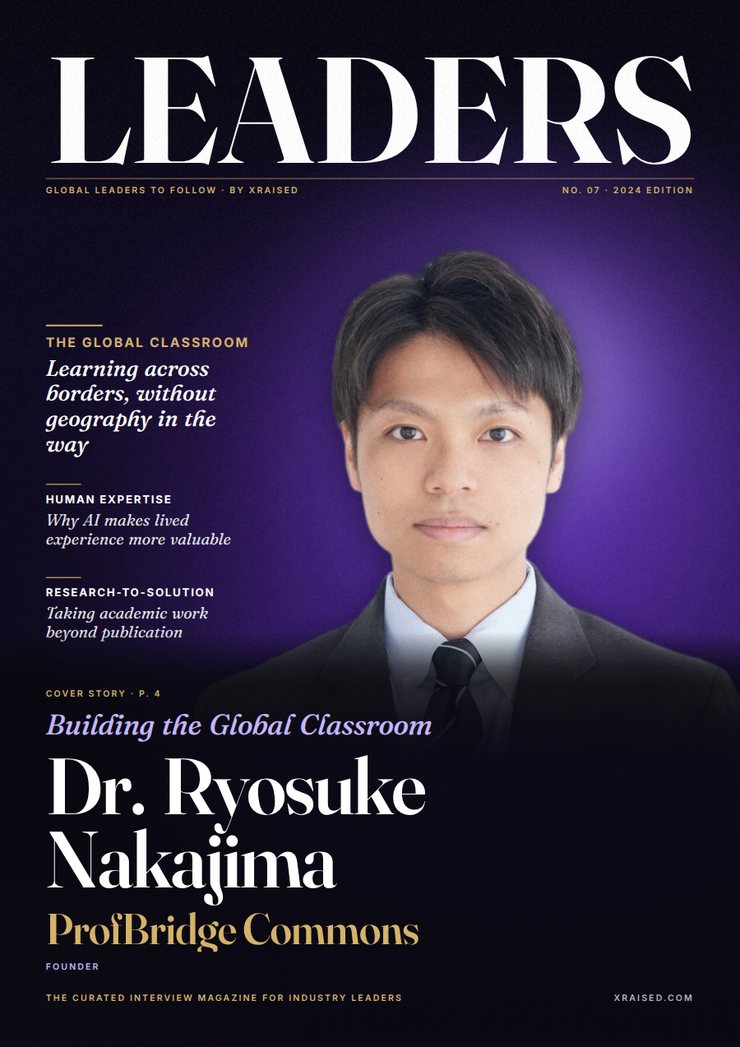
Dr. Ryosuke Nakajima
ProfBridge Commons FounderBuilding the Global Classroom
Consultant, professor and researcher Dr. Ryosuke Nakajima has launched the ProfBridge Platform to connect the world’s professional expertise with the universities, researchers and students who need it.
“Imagine a student in Japan learning from an entrepreneur in the UK, a technology professional in the US, or a researcher in India without geography becoming a major barrier.” That, says Dr. Ryosuke Nakajima, is the kind of global classroom he wants the newly launched ProfBridge Platform to help create.
Nakajima has a foot in both of the worlds he is trying to connect. He is a management consultant at PwC, and over the past decade has supported initiatives in corporate strategy, CRM, operations and IT transformation, global project management and cross-border advisory. In parallel he has built a career in academia. He is adjunct faculty at the Paris School of Management and the Swiss School of Business and Management in Geneva, adjunct professor and dean of the Digital Business Faculty at Tokyo Business and Language College, an adjunct lecturer at GLOBIS University and a guest lecturer at Vishwakarma University in Pune. He holds a Doctor of Business Administration from SSBM Geneva, and his research has explored the metaverse in B2B CRM, the Generative AI Sales Paradox and the governance challenges of AI adoption in multinational firms.
He founded ProfBridge Commons as an independent global initiative to bridge academia, business practice and practical innovation. When he returned to Xraised for a second episode, it was to mark a milestone: the official launch of the ProfBridge Platform.
The problem he describes is not a shortage of knowledge. “There is already an enormous amount of valuable knowledge in the world,” he says. Professionals carry years of real-world experience, researchers are developing new ideas, universities want industry expertise and companies want academic knowledge. “But these people often do not have an easy way to find each other.” The opportunities exist, he argues, but they are scattered across personal networks, universities, companies, LinkedIn posts, conferences and individual introductions.
The platform is his attempt to give them one place to meet. Professionals, academics, researchers and institutions can find collaborations through guest lectures, research projects, case studies, teaching materials, academic opportunities, institutional partnerships and corporate training. “So, I would say ProfBridge Platform is not simply another networking platform,” he says. “It is designed to turn expertise into opportunities, and opportunities into real collaboration.”
He is insistent on simplicity. “We wanted the platform to be very simple.” Users join as a professional or as an institution, build a profile setting out their expertise and the kinds of collaboration they want, and then explore. A professional might discover a university looking for a guest lecturer; a researcher might find a research collaborator; an institution might look for industry experts or international partners. The part Nakajima is most excited about is Research-to-Solution, which aims to help academic research move beyond publication and become a practical solution, product, service or collaboration with industry.
“I actually think the biggest opportunity is in unlocking professional expertise that is currently underutilized in education.” There are millions of professionals, he notes, without doctoral degrees but with deep experience in fields from AI and finance to sustainability, healthcare and entrepreneurship. Many would gladly share it with students or researchers, even through a single guest lecture or a short collaboration. “But most of them simply don't know where those opportunities are.” Universities, meanwhile, want students to understand not only theories and textbooks but what is actually happening in the workplace today. Learners, he believes, stand to benefit most of all.
Nakajima treats the rise of AI as an argument for the platform rather than against it. AI is making information more accessible than ever; explanations, summaries and frameworks can be produced within seconds. “But that actually makes human experience more valuable, not less valuable,” he says. “AI can explain a business framework, for example. But it cannot replace hearing directly from someone who actually led a transformation, made difficult decisions, failed, learned, and tried again.” That kind of implicit knowledge, he says, is still deeply human.
His vision is to make that human expertise more borderless and accessible. “Knowledge should not remain inside one company, one university, one country, or one professional network.” A professor in Europe, he says, should be able to collaborate with a company in Asia; a professional in Japan should be able to teach students in India; a researcher should be able to find an industry partner on the other side of the world.
The platform sits within a wider ProfBridge Commons programme. The initiative also introduces education, AI, technology and business solutions to new markets through global partnerships, and produces research, webinars, publications and interviews, including ProfBridge Talk and ProfBridge Music. The mission running through all of it is to make practical education more accessible, collaborative and globally connected.
For now, Nakajima is candid about the stage he has reached. “We are still at the very beginning, and that is what makes this stage exciting.” The next task is building the first global ProfBridge Commons community, and he is inviting professionals, professors, researchers, universities, companies and institutions to join it. For him, the point was never the software alone. “It is about building bridges between people, knowledge, and opportunities, across industries, institutions, and borders.”