
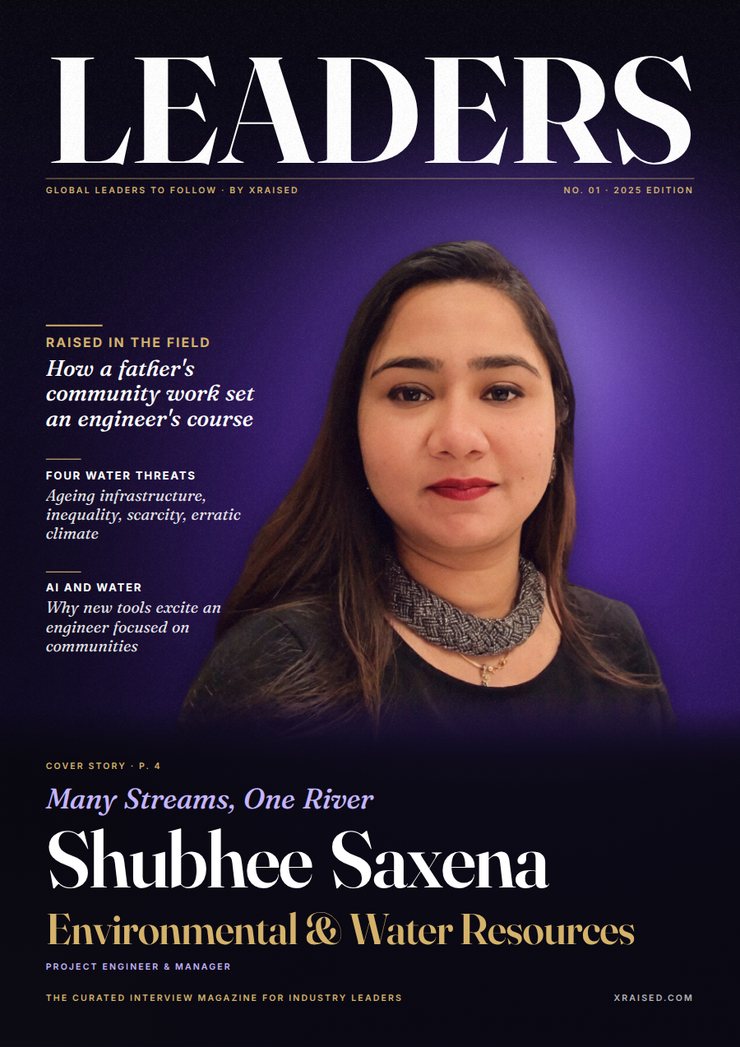
Shubhee Saxena
Environmental & Water Resources Project Engineer & ManagerMany Streams, One River
Shubhee Saxena has worked on water and the environment at every level, from the United Nations to local communities. Her conclusion: no single discipline can solve the water and climate crisis alone.
Long before she had an engineering degree, Shubhee Saxena was learning in the field. Her father, an Energy Engineer and a Water and Sanitation (WASH) Expert, would take her along to his community engagement efforts, so that she learned from an early age and stayed, as she puts it, "grounded and attached to people". It is a lesson she has carried through a career that has taken in the United Nations, national and state agencies, and non-profit and non-governmental organisations.
Her father also pointed her towards the profession. He encouraged her to take civil and environmental engineering rather than settle for a comfortable desk job, even though, as she notes, very few women choose that path. She took the encouragement a long way. Saxena holds a bachelor's degree in civil engineering and two master's degrees, one from the US and one from the UK: a Master's in Water and Environmental Engineering, and a Master's in Water Management and International Development, earned as a Commonwealth Scholar at Loughborough University.
She has served as a World Bank Youth Delegate, and her work has included a role in the Sustainable Urban Development Section of the United Nations Economic and Social Commission for Asia and the Pacific. She has also earned the Qualified SWPPP Practitioner and Qualified SWPPP Developer certifications, alongside the Project Management Professional designation. Backed by internships and research projects, her experience covers sustainable urban water systems, water resource management, sanitation, hygiene and public health, solid and liquid waste management, climate change and renewable energy.
The breadth was deliberate. She has worked for the private sector, for government and for non-governmental organisations, at international, national and local levels, to understand how the work is done from each vantage point. "I tried to develop a holistic viewpoint by gaining as much exposure as I can," she says.
What that exposure taught her is that the same problem looks different depending on where you stand. At each level, problems are identified, prioritised and solved in different ways, with different outcomes, and the decisions eventually trickle down to people. Moving between those levels, rather than staying in one lane, has shown her how solutions conceived at the top must be interpreted and adapted before they can reach the communities that need them most.
Asked what communities are up against, she names four challenges: ageing infrastructure, unequal access, water scarcity and erratic climate patterns. None of them, in her telling, is abstract. She links each one to everyday life, because water is not a peripheral environmental issue. It underpins public health, food security and economic stability, and when water systems fail, people feel it immediately.
Her answer is collaboration. Engineering, public health and sustainability each matter, but she argues that no single field can make a major impact alone; real progress comes when different disciplines act in solidarity for collective betterment. She reaches for an image from her own field to explain it. "It's like multiple small streams coming together to make a big river that can sustain communities." Engineers design the infrastructure, public health professionals make sure it protects wellbeing, and sustainability practitioners make sure it can endure.
Looking ahead, what excites her most is the role of artificial intelligence in the water and environmental sectors. She sees it as a tool that can help practitioners model water systems, predict climate risks, optimise the use of resources and respond faster to environmental crises. Her message for anyone who wants to make a positive impact in the field is to engage with these emerging tools and stay curious, while remembering that the work has real human consequences.
That last point brings her back to where she started, at her father's side in the community. The tools will change, but the principle she took from those early visits holds: the work is measured by what reaches people. For Saxena, what comes next is about bringing more of those small streams together.