
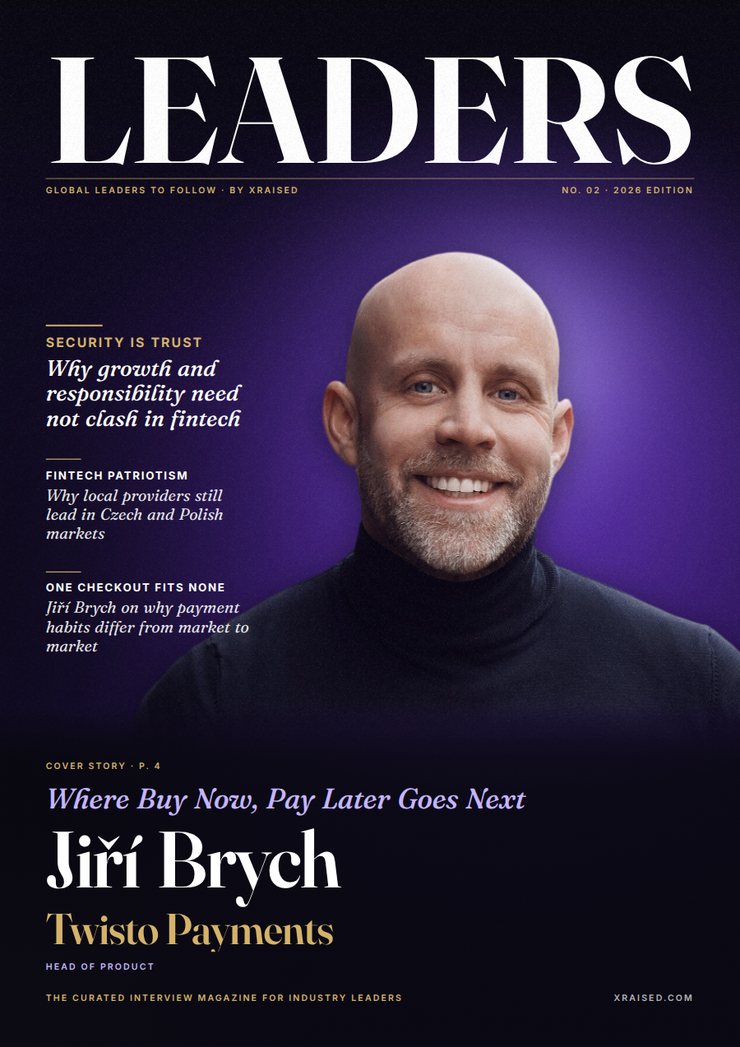
Jiří Brych
Twisto Payments Head of ProductWhere Buy Now, Pay Later Goes Next
Jiří Brych, head of product at Twisto Payments, has spent more than 20 years in fintech. He sees no clash between growth and responsibility — and a clear destination for the industry: accounts.
“I’m sitting in Prague, a very beautiful city,” Jiří Brych says at the start of his Xraised interview, before inviting anyone who has not yet visited to “feel free to jump on a plane and come.” It is a warm opening, and warmth, it turns out, is part of his argument. Brych is head of product at Twisto Payments, and he has been doing this kind of work for more than 20 years, long enough to call himself a fintech veteran.
His remit is broad. He leads three departments at Twisto — product, analytics and design — and is responsible for strategic innovation, actively looking for new opportunities and new markets, as well as for internal processes. Twisto, established in Prague in 2013, began as a buy now, pay later provider. Today, Brych says, it is migrating from that classic model towards accounts and payment cards.
Fintech is often framed as a trade-off between moving fast and being careful. For Brych, “there is no clash between growth and responsibility.” Fintech and banking are specific industries in which security and legal considerations are part of every process, and in his view “the security is equal to trust.” Finance is one of the most important parts of people’s lives; customers who do not believe a provider can keep their money safe will not let it generate revenue at all.
That conviction shapes where Twisto puts its effort. With the rise of AI, Brych says, there are a lot of attempts on the registration process, and the company is investing heavily in fraud detection and in securing its systems. Its legal team and compliance specialists are part of its processes from the very beginning. This, he believes, is how growth is secured, and the only way to become someone’s primary financial partner: who would trust their money to somebody who is not responsible with it?
On the future of buy now, pay later, Brych is direct. It is no secret, he says, that competitors across Europe are going in the same direction. “I believe that the future of our environment or of our business is in an account-based model.” He sees it built around a strong, secure and easy-to-use payment instrument, ideally a card, whether plastic or virtual, permanent or one-off, which lets a provider build a better relationship with its users.
Regulation is pushing the same way. With CCD2, the new wave of consumer credit rules coming from the European Union, he expects there to be essentially no border between buy now, pay later products and credit or account-based ones. That does not mean the model is finished. “I’m not saying that the buy now, pay later model is not relevant anymore, but it’s no longer as attractive as it used to be.” Increasingly, he says, it is an acquisition channel, for Twisto and for its merchants alike.
Brych’s earlier work as a product manager on an e-commerce platform lets him, as he puts it, sit in two chairs. From the merchant’s side, a single payment solution for every market is tempting. In reality, markets and people differ, and so does payment behaviour: customers want to pay with methods they already know. In Poland, he says, a shop without BLIK is basically nothing, because it is much stronger there than Apple Pay or Google Pay — something that surprised him when he first entered the Polish market. He offers a thought experiment: a fashion chain whose headquarters decides to accept only dollars or euros. It may be easy to set up at the till, but “the impact for your revenue and for your customers will be devastating.”
His answer is balance. Cards are easy to implement and work almost everywhere, but local methods matter too, especially in buy now, pay later, where in the Czech and Polish markets he is familiar with “the dominant players are the locals.” Connecting many payment methods can make life messier for finance and reporting teams, he concedes, but “it will be very good news for your customers.” Simply ticking a box at checkout achieves little; ask your users, he advises, and they will tell you which methods they want.
Then there is something no spreadsheet captures. In the Czech Republic, and partly in Poland, Brych sees what he calls fintech patriotism — “but I’m a Czech so I can say it loudly.” People like to support their own payment methods, and Twisto, one of the first fintechs in the country, has become a symbol of innovation that some customers choose out of sympathy. “So this is something that you cannot measure.” Its friendly, honest tone of voice helps too. Twisto provides banking-based products such as credit lines, yet “we are just chatting with you like real friends,” he says — though he doubts the same tone would land in Germany.
He is fair to the big international players, which can sign one contract with a name such as IKEA, Nike or Adidas and simply implement it. But reports and surveys, he argues, cannot let you feel, taste or smell your customers, or notice how something as ordinary as the weather can change their payment behaviour. Local teams can, because “we are our customers as well.” So where does it all end up? For Brych, buy now, pay later remains a way in, but “the final destination will be accounts.”