
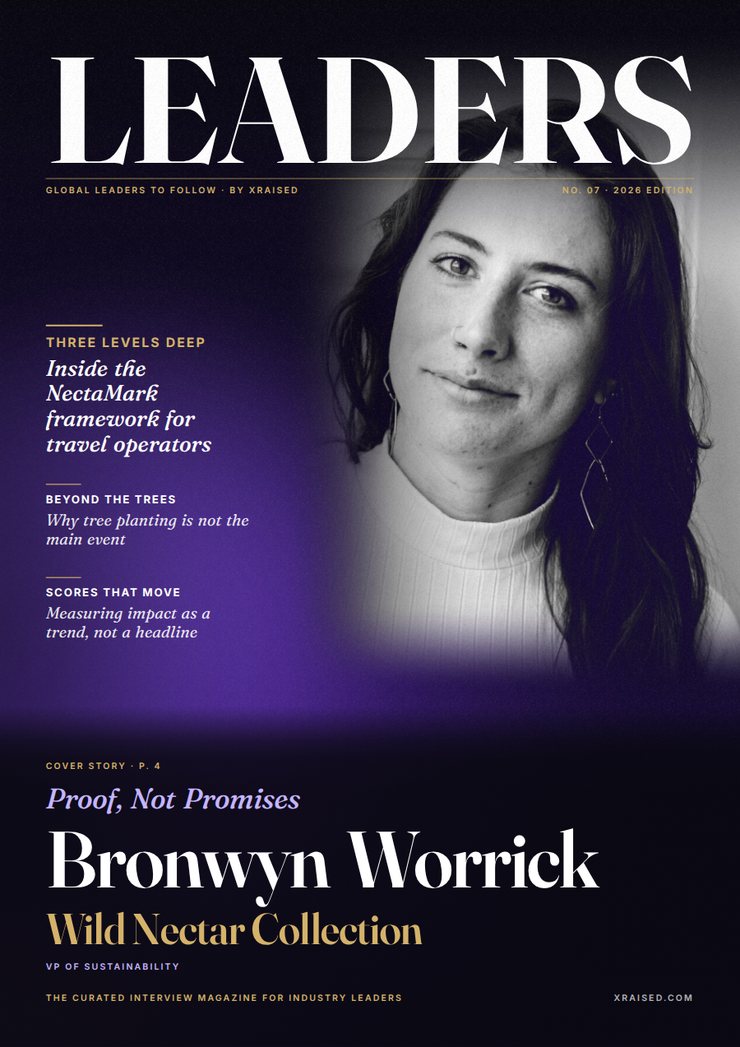
Bronwyn Worrick
Wild Nectar Collection VP of SustainabilityProof, Not Promises
As VP of Sustainability at Wild Nectar Collection, Bronwyn Worrick wants every operator assessed and every trip scored, so that sustainable luxury travel rests on evidence rather than claims.
Anyone trying to travel responsibly faces a familiar problem: endless choice, and sustainability claims that are hard to verify. Bronwyn Worrick has made that problem her job. As VP of Sustainability at Wild Nectar Collection, which designs high-end, immersive journeys for travellers who want their trips to reflect their values, she defines the role in a single line. “My role is to make sustainable travel easy and credible.”
Her starting point is that travel always leaves a mark. “Travel creates real impact on our people, planet, and prosperity.” The question is whether that impact can be seen and measured. Wild Nectar’s answer is to assess every operator it works with through its own NectaMark framework, and to give every trip it sells an Eco Score.
NectaMark works in three levels, each going deeper than the last. The first is a foundational review of an operator’s public information against 10 indicators. The second is a detailed questionnaire covering 67 or more criteria, backed by supporting documentation. The third is an on-site assessment. Across all three, the framework looks at People, Planet and Prosperity: emissions, water, waste and conservation, but also community, safety, labour standards and local economic benefit.
What happens after an assessment matters as much as the score. Every one ends with specific recommendations, and Wild Nectar tracks whether operators act on them and how their scores improve. That improvement, in Worrick’s account, is how the company measures its own impact. It is a demanding test. It asks not whether a partner looked good on the day it was assessed, but whether it got better afterwards.
For travellers, she argues, the benefits go well beyond the environmental. The first is confidence: knowing a journey matches their values without having to research every lodge and operator themselves. The second is simply a better trip. Operators who care about their places and communities “tend to offer the best guiding, the deepest local knowledge and the most genuine welcome.” The third is respectful encounters, and coming home with memories they feel good about.
Alongside the assessments, Wild Nectar keeps three standing corporate commitments. It gives 2% of annual profits to girls’ education and 1% to the Island Ocean Connection Challenge, and plants one tree with Evertreen for every trip booked. Travellers also receive the carbon footprint of their trip, with a link to offset it through Sustainable Travel International. Evertreen was added to round those commitments out, so that every journey also gives back directly to forests and ecosystems.
Worrick is careful not to let the trees become the story. “Tree planting complements our core work rather than replacing it.” The bigger lever, she says, is selectively choosing and supporting the operators that travellers spend time with.
Looking ahead, she expects the industry to move in the direction her own work has taken. Travellers increasingly want, in her words, “proof, not promises”. “I expect verified, evidence-based standards to become the norm in high-end travel.” She would also like to see impact “measured as transparent trends over time rather than single headline numbers”. For Wild Nectar, the next step is deeper assessments across more of its partners, and more opportunities for operators to learn from each other.
In a business built on beautiful places and bold promises, Worrick’s work is to make sure the evidence keeps up.